
Digital Employee Experience Software: What It Is and Best Tools
March 24, 2026
What digital employee experience software does, the key features to evaluate, and 7 platforms compared for 2026. Includes pricing, best-fit recommendations, and selection criteria.
Every interaction your employees have with workplace technology is part of their digital employee experience. The communication tools, feedback platforms, performance systems. All of it!
Digital employee experience (DEX) software measures and improves that experience. Five years ago, this meant engagement surveys. Today, the best platforms combine listening, performance management, organizational analytics, and AI-powered recommendations in one product. This guide covers what DEX software is, what to look for, and the platforms worth evaluating.
Key takeaways:
- DEX software has shifted from annual surveys and HR dashboards to continuous listening with AI-powered recommendations for individual managers.
- The features that matter most are native survey completion inside Slack or Teams, manager-level guidance, and the ability to combine engagement, performance, and collaboration data.
- The current generation of DEX platforms is defined by one shift: moving from data collection to routing specific actions to the leaders who need them.
What is digital employee experience software?
DEX software helps organizations understand how employees experience their work and what to do about it. It spans engagement surveys, pulse listening, performance reviews, 360 feedback, organizational network analysis, people analytics, and AI-driven recommendations.
The old model was simple. Run an annual survey, get a score, present it to leadership, set some company-wide goals. That cycle still exists. Whether it changes anything is another question.
I've seen this across hundreds of organizations. Out of 12 or more improvement areas from a typical engagement survey, most are specific to one team. They need to be fixed by that team's leader. Company-wide programs only address a fraction.

The rest require data to reach individual managers in a form they can actually use. Moving from data collection to routing action is what defines the current generation of DEX platforms.
Why it matters more than ever
According to SHRM, 95% of managers are dissatisfied with traditional performance management processes. Deloitte found that 65% of organizations recognize the need to rethink performance management, but only 6% are making real progress.
Business conditions have tightened. Leaders are managing more with fewer resources, which makes engagement harder to maintain without deliberate support. Hybrid work removed the informal signals managers used to rely on. And AI has raised the bar for what software should do with data once it's collected.
I've seen this firsthand. At one of our customers (roughly 1,000 employees), engagement results showed a 20% gap between how the executive team rated collaboration, strategy clarity, and communication versus how employees actually experienced them.
The executives believed things were fine. The data said otherwise. Without a system that surfaces this gap and routes findings to each relevant manager, it stays invisible for years.
This is what I'd call the hidden cost of mediocre leadership. You're not using a lot of potential. Some people leave, but not enough to trigger a real fix. The whole time, you're losing output.
DEX software, when it works, makes that invisible drag visible and gives someone a specific place to start.

Key features to look for in DEX software
The features below separate platforms that collect data from platforms that drive action. When evaluating DEX software, pay attention to where each tool falls on that spectrum.
Continuous listening
Annual surveys produce data that's months old by the time managers see it. Pulse surveys, run monthly or quarterly, let teams track trends and respond while issues are still fixable. Where surveys happen matters too. Surveys that appear natively inside Slack or Microsoft Teams, requiring a few clicks with no redirect, get dramatically higher participation.
Manager-level recommendations
Giving managers a dashboard is not the same as telling them what to do next. A manager with 15 minutes after a survey closes needs to know who to check in with, what to discuss, what the trends signal. Platforms that deliver that specific guidance are in a different category from those that deliver scores and leave interpretation to the manager.
Performance integration
Engagement data alone captures sentiment at one point in time. Combined with performance reviews, goal tracking, and 360 feedback, it tells you whether declining scores reflect a specific situation, a manager gap, or an org-wide pattern.
Organizational network analysis
Surveys capture what employees say. ONA maps what they actually do, revealing how information flows, who collaborates with whom, where silos form, and who's at burnout risk from over-connection. Surveys surface the symptom. ONA surfaces the cause.
Improve Employee Experience with Leadership Enablement
Managers contribute to 70% variance in employee experience. Improve engagement and productivity levels with a leadership enablement platform.
Learn moreHow to choose the right DEX software
Features lists are useful, but the real decision comes down to a few practical questions. Run through these before you start demos.
- Know your primary user. DEX tools vary widely in who they're designed for. The ones built around HR produce different outputs from the ones built around leaders.
- Test survey completion yourself. Does it happen natively inside Slack or Teams, or does it redirect to a browser portal? This affects response rates more than any survey design decision.
- Ask what managers actually see. Have the vendor show you exactly what a manager gets when results come in. Is it a dashboard they need to interpret, or a specific next step they can act on?
- Match platform to your size. Enterprise platforms carry enterprise pricing and complexity. For 250-2,000 employees, per-seat pricing with fast implementation usually fits better than platforms built for 5,000+ seat deployments.
- Look at the full picture. A standalone engagement tool gives you one signal. A platform that connects engagement, performance, and collaboration data gives you the context to make that signal meaningful.
Best digital employee experience software tools
Each platform below takes a different approach. Some are built for HR analytics teams, others for individual managers. Some require a web portal, others run natively in Slack or Teams. The right fit depends on who needs the data and where your people already work.
Teamspective

Most DEX platforms collect data in one place and expect managers to find it somewhere else. Teamspective removes that gap entirely. Surveys, insights, and AI-powered recommendations all live inside Slack, Microsoft Teams, ChatGPT, Claude, and Microsoft Copilot. Employees never leave their daily tools to give feedback, and managers never need to open a separate dashboard to act on it.
The AI layer does more than surface scores. It analyzes engagement, performance, and collaboration data together, then pushes specific next steps to each manager. Suggested 1:1 topics, who needs attention, what trends mean for their team. Everything is grounded in real team data and aligned with the company's leadership principles.
Best for: Organizations with 250-5,000 employees that want managers to act on people data, using tools they already have open.
15Five

15Five takes a different approach to DEX. Instead of starting with surveys, it starts with weekly check-ins. Managers and employees stay in contact through structured 15-minute updates, and engagement measurement layers on top of that rhythm. The platform also includes performance reviews, OKRs, and a coaching program where HR supports managers through structured development.
Best for: Organizations with a manager-as-coach culture where weekly feedback fits how teams already work.
Workleap Officevibe

Workleap Officevibe focuses on pulse surveys, anonymous feedback, eNPS tracking, and peer recognition. It integrates with Slack and Teams for survey delivery, and delivers insights primarily to individual managers rather than just HR.
The platform is lightweight by design. It works well for smaller organizations that want quick engagement signals without heavy configuration. Limited analytics depth compared to enterprise tools.
Best for: SMBs and mid-market teams (50-750 employees) that want a lightweight, manager-friendly engagement tool with Slack/Teams integration.
TINYpulse (Limeade Listening)

TINYpulse (now part of Limeade Listening) runs short pulse surveys and peer recognition through Slack and Teams. The approach is minimal friction, with single-question pulses designed to maintain high response rates. The platform is focused on culture and retention signals rather than performance management or analytics depth.
Best for: Mid-sized organizations (200-5,000 employees) that want fast, low-friction pulse feedback and peer recognition without a heavy platform.
Jostle

Jostle is primarily an internal communications platform rather than a traditional engagement tool. It covers employee directory, news, announcements, polls, and surveys, with the goal of connecting dispersed teams. Survey and polling functionality exists but is secondary to communications. Analytics focus on content reach and audience engagement rather than engagement drivers.
Best for: Organizations that need an internal communications hub first and lightweight polling second, particularly dispersed or frontline-heavy teams.
Culture Amp
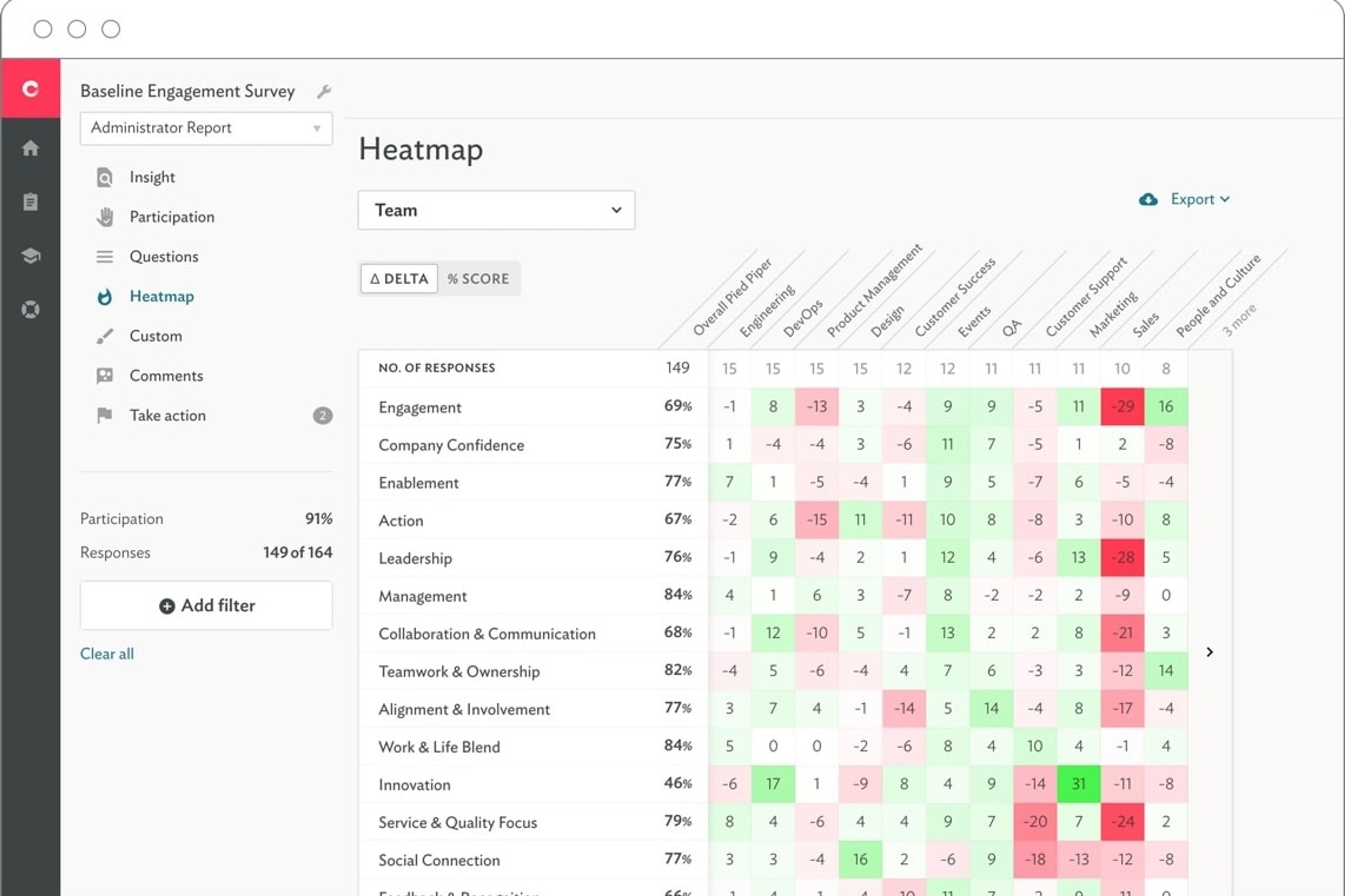
Culture Amp covers the full employee journey lifecycle. Onboarding surveys, engagement pulses, manager effectiveness assessments, exit surveys. Where it's less strong is the last mile. Results land in HR dashboards, and getting those insights to individual managers depends on HR distributing them manually.
Best for: Organizations with a dedicated people analytics function that need benchmarking depth and research-grade measurement.
Lattice
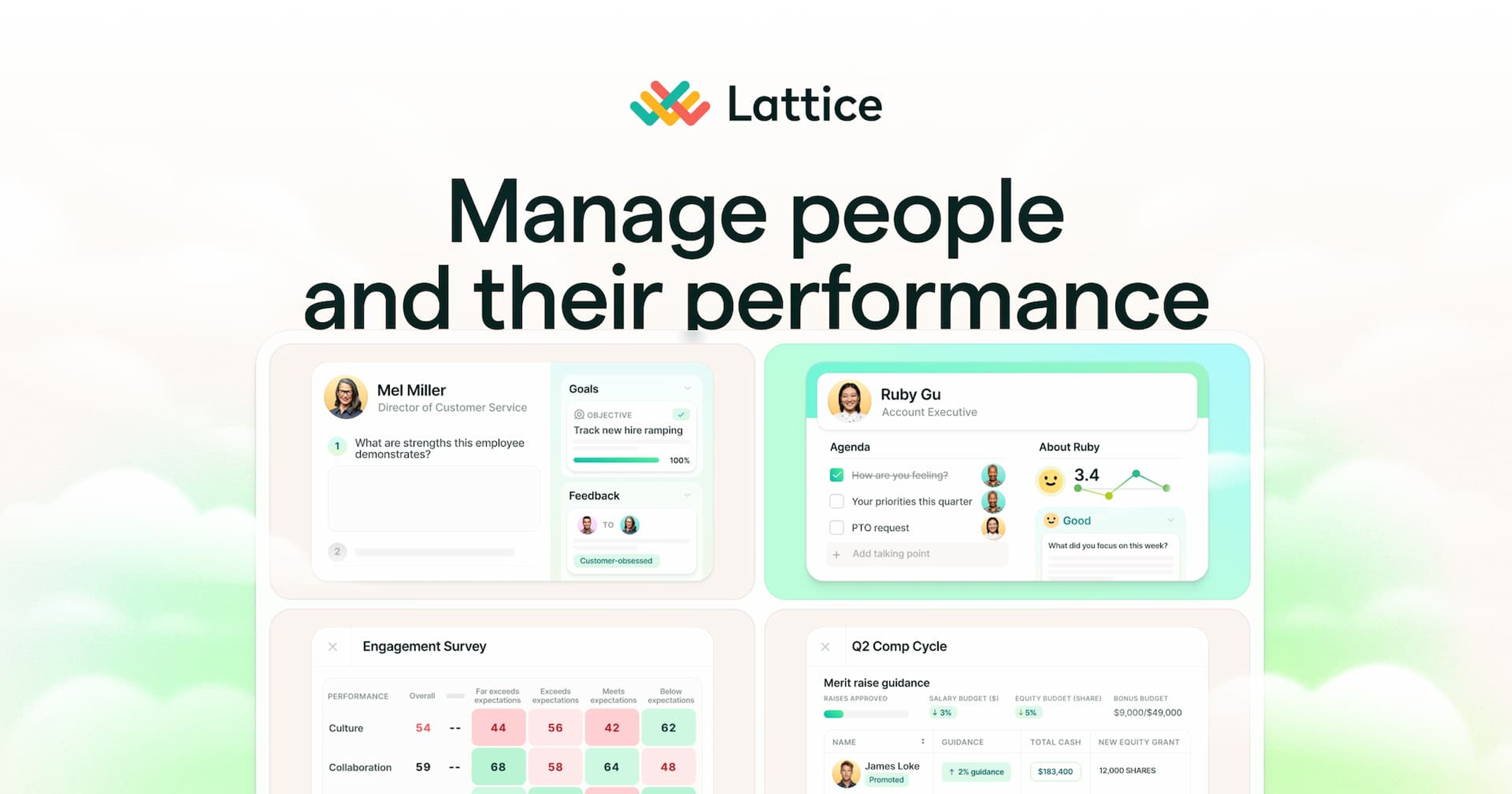
Lattice started as a performance management tool and expanded into engagement. That origin shows. Reviews, OKRs, 1:1 agendas, and compensation management are tightly connected. Pulse surveys do complete natively in Slack and Teams. But once results come in, everything happens in the Lattice web app.
Best for: Organizations where performance management matters as much as engagement, especially those with an OKR culture.
Leapsome

Leapsome treats employee development as the center of the experience. Engagement surveys, reviews, OKR tracking, and learning modules all feed into a single development workflow. Both peer-to-peer and manager-directed feedback are supported. The learning and development module sets it apart from most engagement-first tools.
Best for: Organizations that want development, feedback, and engagement connected in one workflow, with a strong HR team managing the platform.
Microsoft Viva Suite

Microsoft Viva is the employee experience layer on top of Microsoft 365. It includes Viva Insights for productivity and wellbeing analytics from Teams and Outlook data, Viva Connections for internal comms, and Viva Glint for engagement surveys. For organizations on Microsoft 365 and Teams, you get integration within that ecosystem. Viva Insights surfaces wellbeing and collaboration patterns from calendar and Teams data.
Best for: Large enterprises running Microsoft 365 at scale that want engagement analytics inside their existing Microsoft stack.
Qualtrics EmployeeXM

Qualtrics treats employee experience as a research discipline. The survey builder is the most flexible in this category. However, most organizations need a consulting partner to design new survey programs, and the dashboards assume an analyst is interpreting them. Consulting and configuration fees regularly match the software license.
Best for: Large enterprises with a dedicated people analytics or research team that needs maximum survey flexibility and cross-lifecycle measurement.
Workday Peakon Employee Voice

Peakon is the continuous listening platform Workday acquired in 2021. It offers benchmarking data, driver-based engagement surveys, and integration with Workday HRIS. If you're not on Workday for payroll and HR, the integration value disappears fast and the enterprise pricing is hard to justify.
Best for: Large enterprises already on Workday HRIS that want continuous listening inside their existing enterprise stack.
Eletive

Eletive uses machine learning to select survey questions and provides real-time pulse surveys with heatmap visualization, performance management, goal tracking, and 1:1 support. It integrates with Slack and Teams for survey delivery.
The platform emphasizes self-leadership, giving individual employees access to their own engagement data alongside manager views. Less established brand recognition compared to larger competitors. Pricing requires contacting sales across three tiers (Essential, Standard, Professional).
Best for: Organizations that want AI-driven pulse surveys with low admin overhead and a self-leadership approach to engagement.
ThriveSparrow

ThriveSparrow combines engagement surveys with peer recognition (Kudos), performance reviews, and goal management with OKRs. It supports multi-language surveys and QR code distribution for frontline workers. Slack integration handles recognition and notifications, while surveys run primarily through the web portal.
Best for: Growth-focused organizations, particularly those with frontline or multilingual teams that need flexible survey distribution beyond email.
Small Improvements

Small Improvements focuses on lightweight performance management with 360 feedback, 1:1 meeting tools, objectives tracking, and pulse surveys. Slack integration allows employees to respond to pulse surveys directly. The platform is straightforward. It's less a full DEX platform and more a focused performance and feedback tool.
Best for: Mid-market companies (50-750 employees) that prioritize continuous feedback and 1:1 effectiveness over deep engagement analytics.
Motivosity

Motivosity is a recognition and rewards platform with peer-to-peer appreciation, manager recognition, and a rewards marketplace covering gift cards, charitable donations, and custom items. It integrates with Slack and Teams for posting and viewing recognitions directly in those tools. The platform is designed around culture building and social connection rather than deep engagement measurement. Reporting is less detailed than dedicated analytics platforms, and there's a $3,000 minimum annual spend.
Best for: Organizations (200-5,000 employees) that want to build a recognition culture with peer-to-peer appreciation and flexible rewards, particularly those focused on retention and morale.
Conclusion
The DEX category has matured beyond annual surveys and HR dashboards. The platforms that deliver results today meet employees where they already work and give managers specific guidance.
The actual gap in most organizations is the distance between collecting data and getting it to the person who can act on it. Closing that gap is what defines the current generation of DEX software.
If you're evaluating platforms and want to see what manager-level AI guidance looks like in practice, explore Teamspective. Engagement, performance, and ONA in one platform, with recommendations delivered in Slack, Teams, ChatGPT, Claude, and Copilot. Starting at $6.50/seat/month.
Frequently Asked Questions
What is digital employee experience (DEX) software?
Software that measures and improves how employees experience work. Includes engagement surveys, performance management, people analytics, and AI-powered recommendations. The current generation focuses on routing actions to managers.
How is DEX software different from HRIS?
HRIS handles admin (payroll, benefits, compliance). DEX focuses on the experience layer and what actions to take. Most organizations run both. Teamspective integrates with HRIS platforms for data context.
What is Organizational Network Analysis (ONA)?
ONA maps real collaboration patterns using passive data from communication and calendar tools. It reveals silos, bottlenecks, and burnout risk that surveys miss.
Can DEX software improve employee retention?
Yes. It surfaces early signals around manager quality, team dynamics, and disengagement so managers can act before someone decides to leave. Teamspective tracks leading indicators of likelihood to stay.
What should a 500-person company look for in DEX software?
Native Slack/Teams survey completion, manager-level recommendations, per-seat pricing, and fast implementation. Teamspective is built for this segment at $6.50/seat/month, typically live in 2-4 weeks.


