
Top 13 Lattice Competitors and Alternatives in 2026
May 17, 2026
1. Teamspective (best lattice alternative for leadership enablement and continuous performance management); 2. BetterWorks; 3. PerformYard...
Lattice might be one of the best-known performance management tools on the market. But in 2025, Lattice announced it would sunset its HRIS and payroll products by July 2026 to refocus exclusively on performance reviews and OKRs.
That narrower scope leaves a gap. Teams need more than quarterly performance review cycles. They need continuous performance management and need leaders who can act on data every day.
In this article, I'll explain why companies are choosing Lattice competitors, 13 best vendors, and why Teamspective is the best alternative for leadership enablement and continuous performance management.
TL;DR:
- Teamspective: Best Lattice alternative for leadership enablement and continuous performance management. AI guidance delivered in Slack, Teams, ChatGPT, Claude, and Copilot. From $6.50/seat/month.
- Leapsome: Best all-around modern replacement for Lattice, with stronger learning + performance integration.
- Culture Amp: Best for engagement analytics, benchmarking, and people science.
- 15Five: Best for manager-led check-ins and continuous coaching.
- PerformYard: Best for customizable review workflows and simpler implementation.
- BetterWorks: Best for enterprise-scale OKRs and goal alignment.
- HiBob: Best HRIS + performance combo for teams replacing Lattice's sunsetting HRIS module.
What Is Lattice?
Lattice is a people management platform. It helps businesses track performance, set goals, and grow employees. It uses tools like performance reviews, OKRs (objectives and key results), and engagement surveys. Many fast-growing tech companies like its simple design and goal tracking features.
Price Range: Ranges between $14-$22 per employee per month. Extra features cost more.
Best Industries: Technology, Startups, Professional Services, Media
Top Features: Performance reviews, OKR tracking, engagement surveys, career growth tools
Rating: 4.5/5 on Capterra
Explore Lattice Alternatives
Turn insights into action with Teamspective's Leadership Enablement solution.
Schedule DemoWhy Consider Lattice Competitors?
Lattice was one of the first to offer performance review tools. But newer platforms now go beyond tracking. They help leaders grow and teams improve faster. Based on my experience working with many companies, here are common reasons they explore other options.
Narrower Product Footprint
In 2025, Lattice announced it would sunset its HRIS and payroll products by July 2026 to refocus on performance management.
For teams that hoped to consolidate HR data, that pivot creates more dependency on third-party HRIS integrations. And Lattice supports only about 12. If your stack relies on tight data flow between HR systems and performance, Lattice is becoming a thinner slice than it used to be.
Increased Ecosystem Rigidity
Customers increasingly describe Lattice as "becoming less flexible." What started as a nimble, modern platform now requires more workarounds for teams that want to adapt workflows on the fly.
Limited Leadership Development Focus
Many managers say Lattice helps track results, but doesn’t guide them on how to lead better. It shows data but offers little help for turning that data into actions.
Complex Setup for Comprehensive Use
Lattice looks simple in demos. But once companies try to use all its features, the setup gets complex. It takes time and effort to get full value from the tool.
Disconnected Data Sources
Lattice works mostly as a performance tracker. But today’s teams need tools that combine performance, engagement, and communication data. Without this, it’s hard to see the full picture.
Review-Heavy Process Design
Lattice relies a lot on formal reviews. Some teams feel these reviews are too heavy and slow. They prefer quick, ongoing feedback instead.
Signs It’s Time to Explore Alternatives
You may want to consider other tools if:
- You’ve been scaling and now you need to equip your leaders to better support their teams
- Teams are tired of formal reviews that don’t change daily work
- You want to connect performance data with engagement and teamwork insights
- You’re looking for AI-powered support to guide your leaders
- You want a tool that helps leaders act, not just react
Top 13 Lattice Competitors and Alternatives
These 13 tools stand out for their strengths and how they solve common problems Lattice users face.
| Tool | Best for |
|---|---|
| Teamspective | Leadership enablement + continuous performance management |
| Sprad | HR proving skills-to-business impact |
| BetterWorks | Enterprise OKRs and goal alignment |
| PerformYard | Customizable review workflows |
| 15Five | Manager check-ins and continuous coaching |
| Leapsome | All-around modern Lattice replacement |
| Culture Amp | Engagement analytics and benchmarking |
| Workleap Officevibe | Lightweight pulse feedback |
| Cornerstone OnDemand | Enterprise talent management suite |
| Quantum Workplace | Mid-size practical performance + engagement |
| Glint (Microsoft Viva) | Microsoft 365 ecosystem |
| Bonusly | Peer recognition and rewards |
| HiBob | Modern HRIS + performance for growing teams |
1. Teamspective: The Best Lattice Alternative for Leadership Enablement and Continuous Performance Management

I’ve helped clients use Teamspective when they needed to turn data into action. The results have been strong. Teamspective blends performance tracking, engagement surveys, and team analysis into one smart system.
Best for: Companies that want continuous performance management and leadership enablement in one platform
Key Features:
- Performance reviews, employee surveys, and teamwork analysis in one tool
- AI agent that finds problems, gives advice, and supports managers
- AI insights and recommendations delivered in Slack, Teams, ChatGPT, Claude, and Microsoft Copilot (every recommendation ties back to your specific values, policies, and team signals)
- Organizational Network Analysis (ONA) to show team dynamics
- Integrates with Slack, Teams, and 60+ HRIS systems
- Dynamic cohort analysis of engagement data by eNPS group (Promoters, Passives, Detractors), tenure, team, location, or any HRIS field
- Smart AI features for faster decisions and better leadership
- Content localized and adapted for each market, appropriate question framing for European, Nordic, and APAC contexts.
Why it’s a great Lattice alternative: Lattice tracks goals. Teamspective goes deeper. It pairs continuous performance management with leadership enablement, so managers don't wait for quarterly reviews to see what's happening. They get AI-powered guidance in Slack, Teams, ChatGPT, Claude, and Copilot, fed by data from 60+ HRIS integrations.
2. Sprad

Sprad connects performance, 360° feedback, and skills with business data. Atlas AI predicts turnover, maps skills to revenue outcomes, matches internal talent to roles.
Best for: HR proving skills-to-business impact.
Features:
- Atlas AI Agent (proactive insights & coaching)
- Predictive retention analytics
- Skill-to-outcome mapping (32,000+ taxonomy)
- Business data integration (CRM, finance, HRIS)
- Internal mobility matching
Why it's a great Lattice alternative: Shows which skills drive revenue and who's at risk, connecting talent to business outcomes, not just goal tracking
3. BetterWorks

BetterWorks is great for big companies with complex structures. It offers strong OKR tools that help connect employee goals with business goals.
Best for: Large companies that need advanced goal tracking
Key Features:
- Enterprise-level OKR tools
- Goal alignment features
- Performance calibration
- Reports and dashboards
- Integrates with business software
Why it’s a great Lattice alternative: BetterWorks gives better control and tracking for large teams. Lattice can’t always keep up with those needs at scale.
4. PerformYard

If your team needs custom workflows, PerformYard offers flexible tools. You can shape the process to fit your company’s needs.
Best for: Companies that want flexible performance tools
Key Features:
- Fully customizable reviews
- 360-degree feedback
- Goal tracking and alignment
- Links to pay and bonus systems
- Multi-rater feedback
Why it’s a great Lattice alternative: PerformYard gives you more control. You can set up processes that match your team’s culture, not fit into Lattice’s template.
5. 15Five

15Five promotes weekly check-ins instead of just yearly reviews. It helps managers and teams stay in sync more often.
Best for: Teams that want ongoing conversations
Key Features:
- Weekly check-ins
- Pulse surveys
- 1-on-1 meeting tools
- Recognition tools
- Coaching resources
Why it’s a great Lattice alternative: 15Five makes feedback more frequent and useful. It builds a rhythm that supports growth.
6. Leapsome

Leapsome ties performance and learning together. It helps employees build new skills based on feedback.
Best for: Companies focused on skill-building and learning
Key Features:
- Learning management tools
- Development plans with reviews
- OKR tracking
- Surveys for employee engagement
- Manager training modules
Why it’s a great Lattice alternative: Leapsome turns reviews into learning plans. It links feedback directly to employee growth.
7. Culture Amp
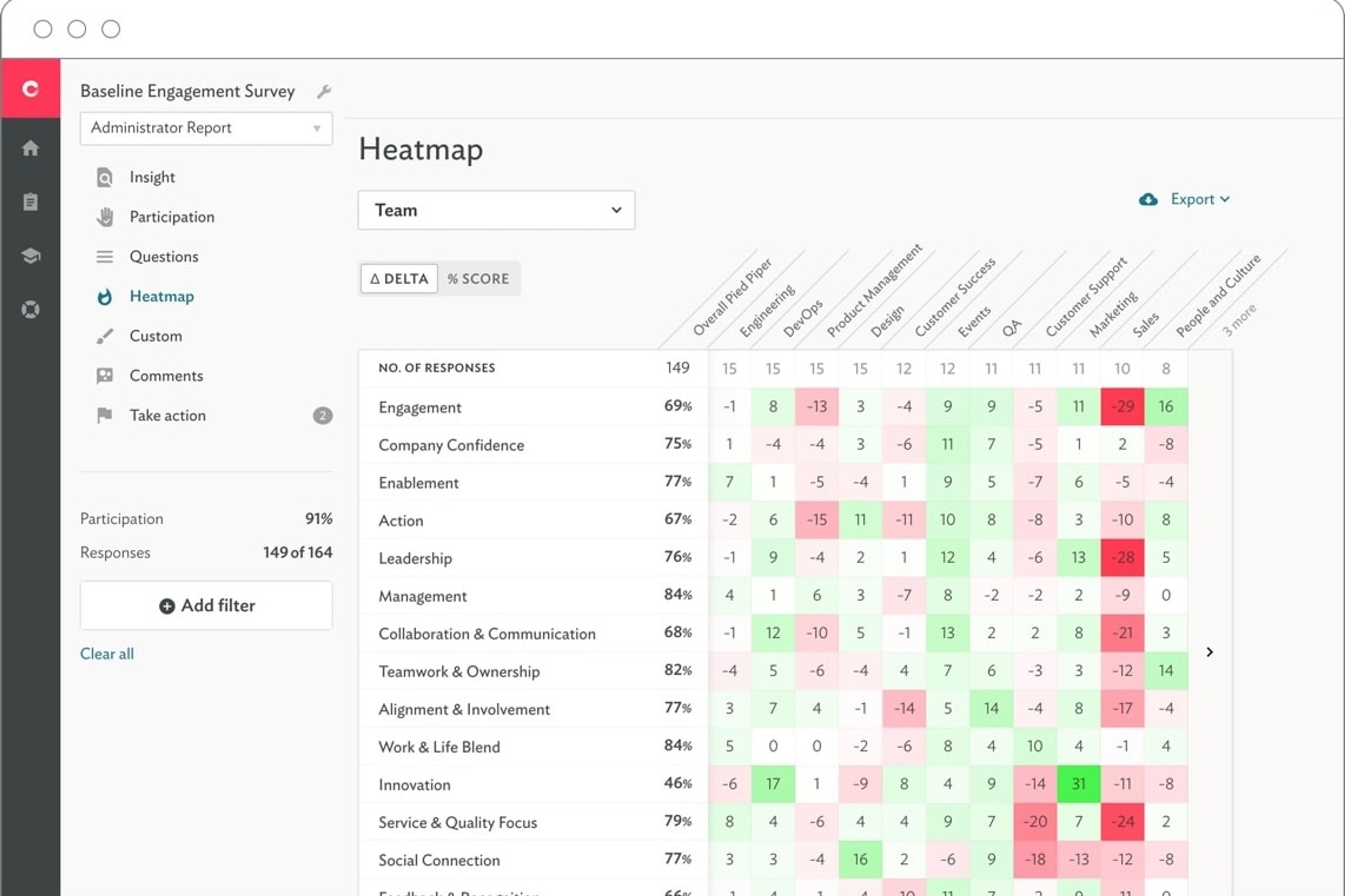
Culture Amp uses research to help you understand how engagement drives performance. It’s a data-rich platform.
Best for: Companies that want deep insights into people and performance
Key Features:
- Engagement surveys
- Reviews tied to engagement
- Benchmarking tools
- Analytics dashboards
- Action planning
Why it’s a great Lattice alternative: Culture Amp gives better data and science-backed insights than Lattice, helping you understand what really drives results.
8. Workleap Officevibe

Officevibe focuses on small, regular check-ins. This approach is less intense than Lattice’s full review process.
Best for: Teams that want simple, regular feedback
Key Features:
- Weekly pulse surveys
- Team dashboards
- 1-on-1 support tools
- Anonymous feedback
- Recognition programs
Why it’s a great Lattice alternative: Officevibe gives fast insights and keeps team health on track without overwhelming people.
9. Cornerstone OnDemand

Cornerstone offers a full suite of HR tools, not just performance management. It’s better for companies that want one system for everything.
Best for: Enterprises that need complete talent management
Key Features:
- Performance tracking
- Learning and development
- Succession planning
- Hiring and onboarding
- Compliance training
Why it’s a great Lattice alternative: Cornerstone covers the full employee journey.
10. Quantum Workplace

This platform gives mid-sized businesses a simple way to manage performance and engagement at the same time.
Best for: Mid-sized companies wanting practical tools
Key Features:
- Reviews and goal tracking
- Engagement surveys
- Action planning
- Recognition tools
- Manager support resources
Why it’s a great Lattice alternative: Quantum Workplace helps managers turn feedback into action. It gives better support tools than Lattice.
11. Glint (Microsoft Viva)

Glint works well with Microsoft tools. If your company already uses Microsoft 365, this may be the smoothest option.
Best for: Companies using Microsoft tools
Key Features:
- Deep Microsoft integration
- Performance and engagement tracking
- Team analytics
- Manager insights
- Action plans
Why it’s a great Lattice alternative: Glint connects easily with Microsoft products, making setup simple and insights easier to share.
12. Bonusly

Bonusly encourages peer feedback. It’s more fun and focused on recognition than formal reviews.
Best for: Companies that value recognition and team spirit
Key Features:
- Peer recognition
- Feedback from rewards data
- Team insights
- Custom rewards
- Integrates with Slack, Teams, and more
Why it’s a great Lattice alternative: Bonusly creates a more positive culture. It focuses on praise, not just performance issues.
13. Hibob

Hibob is a modern HR platform that includes performance tools. It’s great for growing companies that want more than just reviews.
Best for: Growing teams that need full HR tools
Key Features:
- Integrated HR and performance
- Engagement surveys
- Onboarding tools
- People analytics
- Culture tracking
Why it’s a great Lattice alternative: Hibob does more than Lattice. It’s a better fit for companies that want one system for many HR needs.
Why Modern Leaders Choose Teamspective Over Lattice
Lattice and Teamspective have different goals. Lattice tracks performance. Teamspective takes HR out of that middleman role: insights and recommendations go directly to each manager, in Slack, Teams, ChatGPT, Claude, or Copilot. Combined with Lattice's HRIS and payroll products sunsetting by July 2026, that gap has only widened.
Leadership Development, Not Just Tracking
Lattice shows what happened. Teamspective shows what to do next. It gives managers real tips on how to lead better, based on real data.
Simple Setup, Immediate Value
Teamspective is easy to install. It works inside tools your team already uses, like Slack or Teams. Managers get insights fast, without long setup or training.
Integrated Insights, Not Isolated Data
Teamspective blends performance data, engagement results, and team dynamics into one platform. No need to switch tools to get the full picture.
Continuous Performance Management vs. Quarterly Reviews
Lattice still leans on formal review cycles. Teamspective runs continuous performance management: pulse surveys, lightweight check-ins, and AI-generated insights flow to managers every week. Real-time feedback helps leaders course-correct in days, without waiting for a formal program to start.
Conclusion
Performance tools have changed a lot. Today, teams need more than goal tracking and quarterly reviews. They need continuous performance management and tools that help managers lead better every day.
With Lattice's HRIS and payroll products sunsetting by July 2026, the platform is narrowing to performance reviews and OKRs. Teamspective is the better fit for teams that want both: continuous performance management and leadership enablement, in one platform.
Ready to transform performance management into leadership enablement? Book a personalized demo today to see how Teamspective helps managers lead with impact.
Frequently Asked Questions
What is Lattice used for?
Lattice is a people management platform focused on performance reviews, OKR tracking, engagement surveys, and career development. It's widely used in fast-growing technology and startup companies that want to connect goal-setting with employee growth in one place.
How much does Lattice cost?
Lattice ranges between $14–$22 per employee per month depending on the modules included. Additional features like compensation management cost extra. For mid-to-large teams, the all-in cost can be considerably higher than the base price suggests.
What are the main weaknesses of Lattice?
Lattice shows managers data but rarely tells them what to do. It leans on formal reviews instead of continuous feedback. And with Lattice sunsetting its HRIS and payroll products by July 2026, the platform is narrowing further.
What is the best Lattice alternative?
Depends on what's missing. Teamspective is the best Lattice alternative for leadership enablement and continuous performance management. It combines engagement surveys, performance reviews, and ONA in one platform and delivers AI guidance in Slack, Teams, ChatGPT, Claude, and Copilot. From $6.50/seat/month.
Can Lattice replace a traditional performance review process?
Lattice can structure performance reviews, but whether it replaces your traditional process depends on how much you rely on custom workflows. Companies with highly specific review needs often end up adapting to Lattice's structure rather than the other way around.


