
26 Best Talent Management Software Tools in 2026
March 6, 2026
A practical guide to 26 talent management software tools in 2026, organized by the problem they solve — from leadership enablement to hiring, learning, and workforce analytics.
Best talent management software in 2026: 26 tools compared
Most organizations use a combination of tools rather than one all-in-one suite. The right choice depends on whether you need breadth across the lifecycle or depth in a specific area like hiring, engagement, or learning. In this article, we break down 26 platforms organized by the problem they solve best.
Key findings
- The global talent management software market was valued at approximately $9.96 billion in 2023 and is projected to reach $22.67 billion by 2030, growing at a 12.5% CAGR, as organizations replace annual HR processes with continuous, data-driven ones.
- Global employee engagement fell to 21% in 2024 — only the second decline in 12 years — costing the world economy $438 billion in lost productivity, according to Gallup's State of the Global Workplace 2025 report. The primary driver was falling manager engagement.
- Replacing an employee costs between 50% and 200% of their annual salary depending on seniority and role, making retention tools among the highest-ROI investments in HR.
- Talent management software spans six core subcategories: applicant tracking, onboarding, performance management, learning and development, employee engagement, and succession planning — plus newer categories like leadership enablement and workforce analytics.
- The market has shifted away from annual review cycles and annual surveys toward continuous feedback, pulse listening, and real-time manager guidance — tools that address problems before they escalate.
Quick guide: start with your problem
- Improve engagement through leadership quality → Teamspective
- Bring structure and consistency to hiring → Greenhouse or iCIMS
- Regular performance conversations → Lattice or 15Five
- Upskill your workforce at scale → Cornerstone OnDemand or Degreed
- Develop future leaders from within → Gloat or Eightfold
- Manage HR, payroll, and talent in one global system → Workday or SAP
What is talent management software?
Talent management software is an HR technology that supports people strategy across the full employee lifecycle — from attracting and hiring through to performance, development, and succession planning.
The most common subcategories are:
- Applicant Tracking Systems (ATS): Tools for managing the hiring process, from job posting through to offer management.
- Onboarding software: Platforms that help new hires get productive faster and reduce early attrition.
- Performance management: Systems for goal setting, continuous feedback, and performance reviews.
- Employee engagement: Employee surveys and listening tools that help leaders understand how their teams are feeling and what's driving performance.
- Learning Management Systems (LMS): Platforms for delivering, tracking, and measuring employee training and development.
- Succession planning: Tools for identifying and developing future leaders within the organization.
- Leadership enablement: A newer category that combines engagement, performance, and collaboration data to help managers take better action.
Many enterprise suites try to cover all of these in one platform. Specialized tools go deep on one or two. The right choice depends on whether you need breadth or depth, and whether your leaders actually have time to use what you give them.
Normalize excellent leadership
Support your leaders and team managers with the talent management software, designed to provide leaders with the right guidance at the right time.
Learn more26 best talent management software tools in 2026
Below are 26 platforms organized by subcategory. Each one solves a different piece of the talent management puzzle, so start with the problem you're trying to fix.
Leadership enablement
These platforms go beyond traditional HR tools to help leaders act on data in real time. Rather than giving HR more reports, they put the right information in front of each manager at the right moment.
1. Teamspective

Best for: Mid-to-large organizations that want every manager to have personalized, data-driven guidance based on what's actually happening in their teams.
Teamspective is a Leadership Enablement Platform that combines employee engagement, performance management, and Organizational Network Analysis (ONA) in one place. It runs natively inside Slack and Microsoft Teams, which means employees answer surveys and give feedback where they already work — without switching to a separate app. This drives significantly higher response rates than browser-based alternatives.
- Pulse surveys, 360 feedback, and performance reviews delivered directly in Slack or Microsoft Teams
- Organizational Network Analysis (active and passive) that identifies silos, bottlenecks, and burnout risks across the org
- AI-generated 1:1 discussion points and meeting preparation, aligned to your company's leadership principles
- Talent review and succession planning tools for mapping performance and potential
- Integrations with 60+ HR systems, SSO via Entra ID and Okta
Pricing: Starts at $6.50/seat/month, custom pricing for enterprise companies.
Full-suite HCM platforms
These platforms cover the broadest range of HR functions in a single system. They're built for large organizations with complex, global HR needs. Implementation is heavy, but the payoff is a unified view of your workforce.
2. Workday HCM

Best for: Mid-to-large enterprises that need a unified HR and finance system with strong analytics.
Workday is one of the most widely adopted HCM platforms globally, used by companies like Netflix and Target. It covers core HR, payroll, talent management, learning, and workforce planning in a single cloud-native system. Its Illuminate AI sits across the platform to surface insights and automate recommendations.
- Core HR software, payroll, and global compliance in one system
- Performance reviews, goal setting, and succession planning
- Workday Learning for skills-based development and training
- Workforce planning and headcount forecasting
- Strong analytics and reporting capabilities
Pricing: Custom pricing per employee per month. Contact Workday for a quote.
3. SAP SuccessFactors

Best for: Large multinational enterprises, especially those already using SAP's ERP ecosystem.
SAP SuccessFactors is a modular HCM suite that covers the entire employee lifecycle. Its deep integration with SAP's finance and supply chain systems is a major advantage for companies already running on SAP. BMW used it to align their global workforce strategy across 100+ countries during a major digital transformation.
- Modular suite: core HR, recruiting, onboarding, learning, performance, and succession
- Joule AI copilot embedded across modules for faster workflows
- Global payroll support for 49 countries
- Native integration with SAP S/4HANA and SAP BTP
- Workforce analytics and advanced reporting
Pricing: Subscription-based, modular pricing. Not publicly disclosed. Contact SAP for a quote.
4. Oracle Cloud HCM

Best for: Large enterprises with complex global HR needs that require deep configurability and tight ERP alignment.
Oracle Cloud HCM covers the full employee lifecycle and is deeply integrated with Oracle's finance and operations suite. Deutsche Bahn and Virgin Media run their global HR on it. Its Oracle ME product provides a complete employee experience platform built on top of the HCM core.
- End-to-end HCM: global HR, recruiting, learning, performance, and workforce management
- Oracle ME employee experience platform with personalized employee journeys
- Embedded AI for attrition prediction and skills gap identification
- Deep integration with Oracle ERP and CX systems
- Strong global compliance and multi-jurisdiction payroll support
Pricing: Tiered pricing model. Not publicly disclosed. Enterprise-level investment. Contact Oracle for a quote.
5. UKG Pro

Best for: Mid-to-large businesses that want strong workforce management alongside HCM, particularly for shift-based or hourly workforces.
UKG Pro (formerly Ultimate Software) combines core HR, payroll, time tracking, and talent management in one platform. It has a strong focus on workforce culture and employee sentiment, using AI to assess engagement and flag cultural risks before they become retention problems.
- Core HR, global payroll, and time & attendance in one system
- AI-driven employee sentiment analysis across the workforce
- Performance and succession planning tools
- Pre-built integrations with leading ERP, CRM, and HR systems
- Strong compliance and global expansion capabilities
Pricing: Custom pricing. Contact UKG for a quote.
Performance management
Performance management tools focus on goal setting, continuous feedback, and employee reviews. The market has shifted away from annual reviews toward more frequent, lightweight check-ins that keep managers and employees aligned throughout the year.
6. Lattice
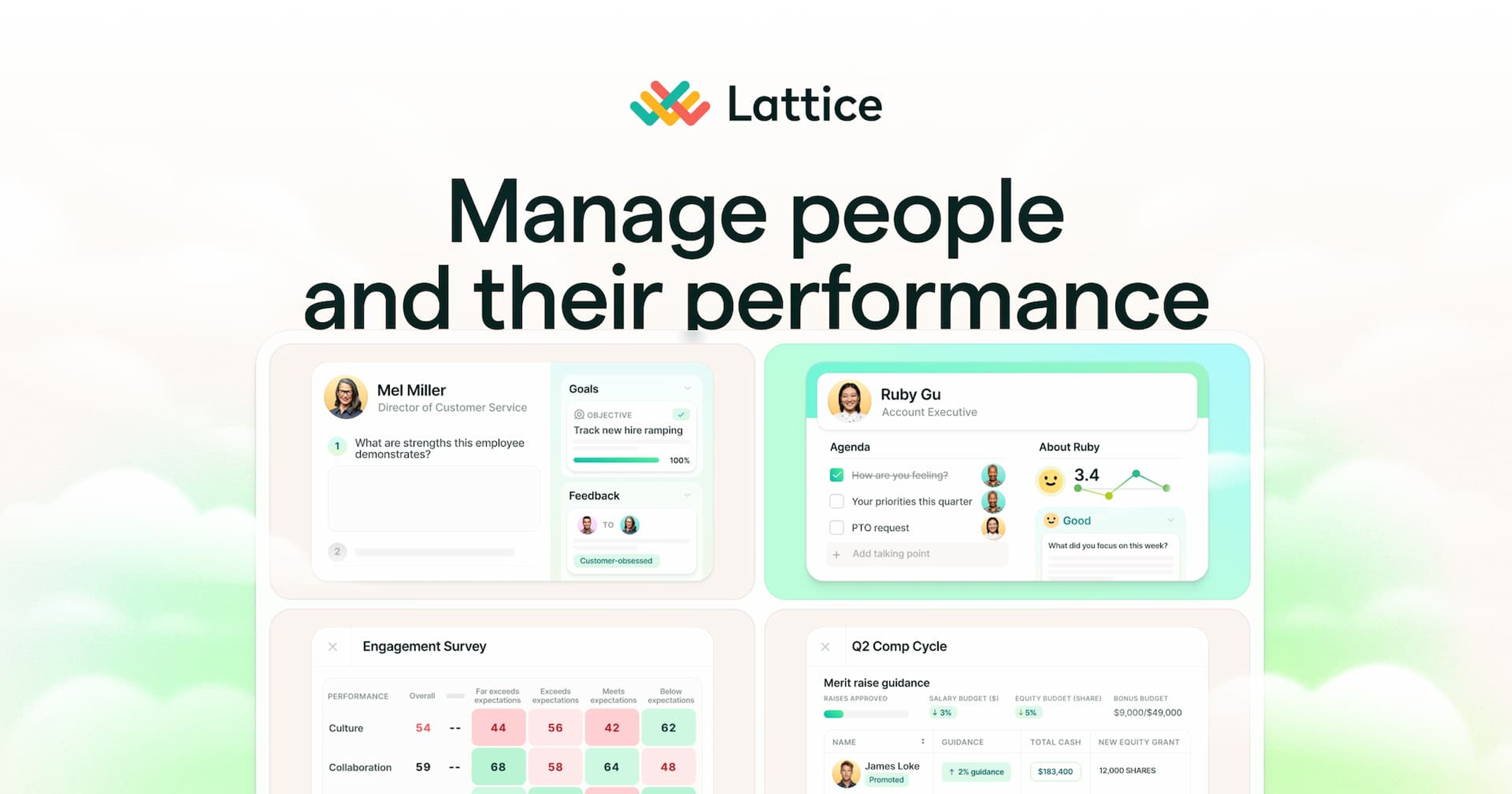
Best for: Mid-to-large organizations looking for a comprehensive performance and engagement platform with a strong user experience.
Lattice combines performance reviews, OKR tracking, engagement surveys, and career development in one place. In recent years, it has added HRIS capabilities, making it a stronger option for teams that want to consolidate HR systems.
- Performance reviews, 360 feedback, and OKR/goal management
- Employee engagement surveys and pulse checks
- Career development and growth plans
- Analytics that connect performance trends to business outcomes
- Integrations with Slack, Teams, BambooHR, Workday, and more
Pricing: Starts from around $11/user/month for the performance module. Custom pricing for bundles. Contact Lattice for details.
7. 15Five

Best for: Small-to-mid-sized companies that want a straightforward, manager-friendly performance platform built around continuous feedback.
15Five pioneered the continuous performance check-in model and remains one of the most practical tools for managers who want to stay on top of team health without drowning in process. Its Engage module focuses on pulse surveys; its Perform module covers the full performance cycle.
- Weekly check-ins and continuous feedback tools for managers
- 360-degree performance reviews and talent assessments
- Engagement surveys and AI-driven insights
- OKR and goal tracking with alignment visibility
- Integrations with major HRIS and communication tools
Pricing: Engage starts at $4/user/month. Perform starts at $10/user/month. Enterprise pricing on request.
8. Leapsome

Best for: Fast-growing mid-market companies that want performance management, learning, and engagement in one platform.
Leapsome has expanded significantly from its performance management roots. It now covers onboarding, engagement surveys, learning management, and career pathing alongside its core performance and feedback tools. It's a solid option for organizations that want enterprise-grade features without enterprise complexity.
- Performance reviews and 360 feedback with customizable workflows
- OKR and goal management tied to individual reviews
- Integrated LMS for employee learning and development
- Engagement surveys and people analytics
- Career pathing and development plans
Pricing: Custom pricing. Contact Leapsome for a quote.
9. Culture Amp
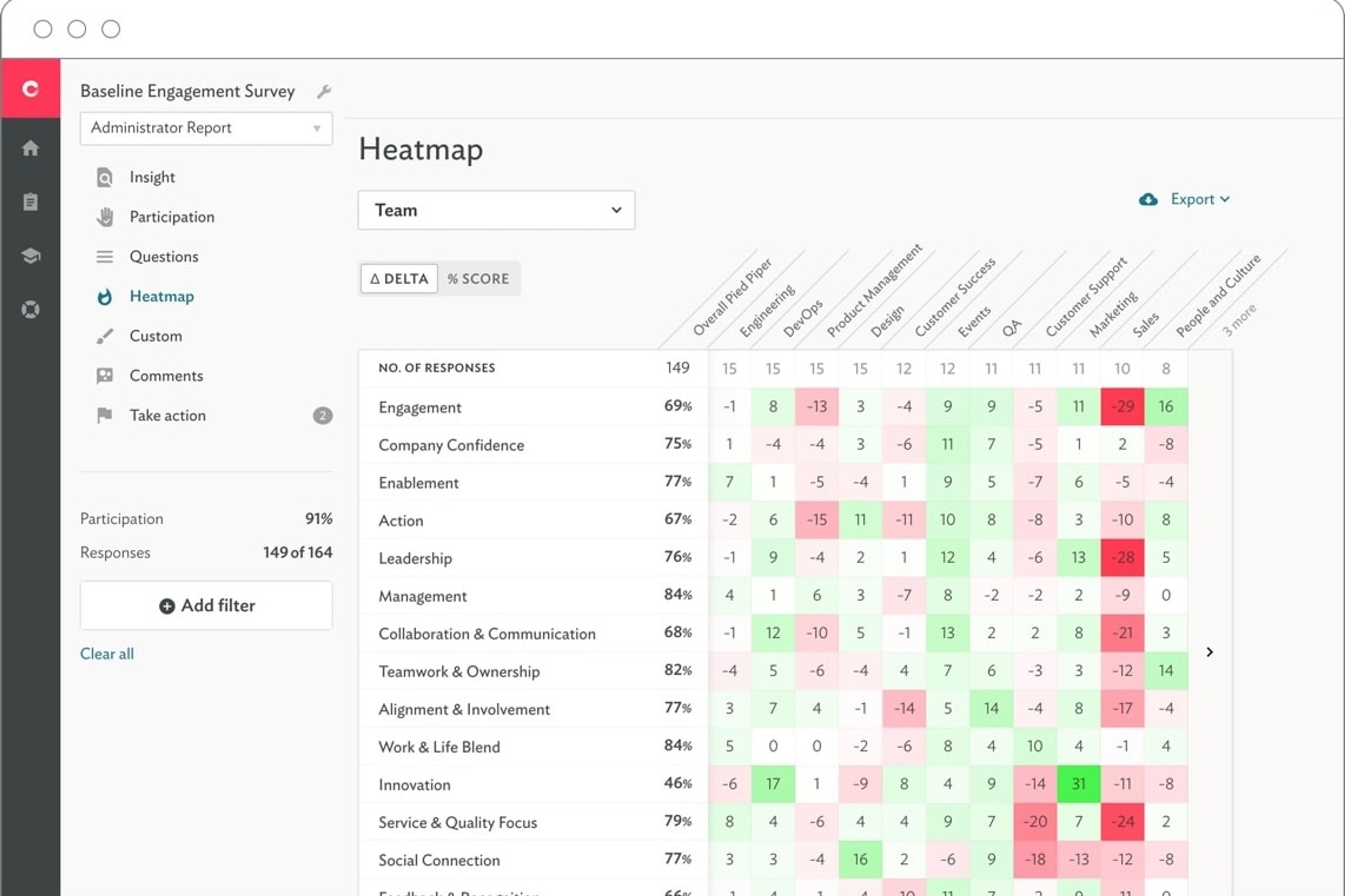
Best for: Organizations that want deep survey analytics combined with performance management.
Culture Amp built its reputation on the quality of its engagement survey methodology. Its tools help organizations ask the right questions, understand what the data means, and take targeted action. Its acquisition of a performance management product has brought these two capabilities together under one roof.
- Employee engagement surveys with psychology-backed question design
- Performance reviews, continuous feedback, and goal management
- People analytics and manager dashboards
- Onboarding and exit surveys for full lifecycle listening
- Integrations with Workday, BambooHR, Slack, and Teams
Pricing: Custom pricing based on company size. Contact Culture Amp for a quote.
Talent acquisition
Applicant tracking systems manage the hiring process from job posting to offer. The focus in recent years has shifted toward AI-powered screening, collaborative hiring, and better candidate experience.
10. Greenhouse

Best for: Mid-to-enterprise companies that want structured, data-driven hiring with strong collaboration tools.
Greenhouse is consistently rated among the top ATS platforms for the quality of its interview structure, analytics, and integrations. It's built around the idea that great hiring requires a repeatable, disciplined process, and it gives teams the tools to achieve that across every role and every hiring manager.
- Structured interview kits and scorecards for consistent evaluation
- AI-powered candidate matching and resume screening
- Collaborative hiring workflows with role-based permissions
- DEI reporting and sourcing analytics
- 600+ integrations including LinkedIn, Workday, and major HRIS platforms
Pricing: Tiered, quote-based pricing. Plans (Essential, Advanced, Expert) scaled by company size and hiring volume. Contact Greenhouse for a quote.
11. Lever

Best for: Growing companies that want to combine applicant tracking with candidate relationship management in one platform.
Lever combines a traditional ATS with a candidate relationship management (CRM) system, making it easier to nurture passive candidates over time and build talent pipelines ahead of hiring need. It's well-suited for companies with high-growth hiring plans that want to stay ahead of demand.
- Integrated ATS and CRM in one platform
- AI-powered resume parsing and candidate matching
- Nurture campaigns for passive candidate engagement
- Interview scheduling, feedback forms, and collaborative hiring
- Integrations with Slack, Teams, LinkedIn, and major HRIS systems
Pricing: Quote-based pricing. Contact Lever for details.
12. iCIMS

Best for: Enterprise organizations with complex, high-volume recruiting needs and strict compliance requirements.
iCIMS is one of the most configurable enterprise ATS platforms on the market, used by large organizations in healthcare, finance, government, and manufacturing. Its depth and flexibility make it a strong fit for organizations with complicated hiring workflows across multiple locations or regulatory environments.
- Highly configurable applicant tracking with advanced workflow management
- AI-powered candidate matching and screening tools
- Integrated talent CRM for pipeline building and passive candidate nurturing
- Enterprise-grade compliance: GDPR, EEOC, OFCCP reporting
- Broad integration ecosystem with major HRIS and background-check providers
Pricing: Quote-based pricing. Starter packages estimated at $9,000–$15,000/year, scaling for enterprise. Contact iCIMS for a quote.
Onboarding
Onboarding software helps new hires get productive faster and reduces early attrition. The best tools do more than digital paperwork — they help new employees understand the culture, connect with colleagues, and find their footing in the role.
13. BambooHR

Best for: Small to mid-sized businesses that want an easy-to-use HR platform covering onboarding, employee records, and basic performance management.
BambooHR is one of the most popular HR platforms for growing companies that want to get out of spreadsheets without the complexity of an enterprise system. Its onboarding flows are clean, its interface is intuitive, and it gives HR teams a solid foundation without requiring dedicated IT support.
- Automated onboarding checklists, e-signatures, and welcome emails
- Centralized employee records and self-service profiles
- Performance reviews and goal tracking
- Time off management and reporting
- Pre-built integrations with payroll providers and HRIS systems
Pricing: Not publicly listed. Based on number of employees. Contact BambooHR for a quote.
14. WorkBright

Best for: Companies with high-volume, distributed, or seasonal workforces that need fast, mobile-first onboarding.
WorkBright is built for organizations that need to onboard large numbers of employees quickly, often in field-based roles. It prioritizes mobile completion, digital I-9 verification, and fast turnaround times, making it particularly strong for healthcare staffing, logistics, and retail.
- Mobile-first onboarding that new hires can complete from any device
- Digital I-9 verification with remote inspection support
- Automated compliance alerts and document tracking
- E-signatures for all required documents
- Integration with major ATS and HRIS platforms
Pricing: Pricing based on number of onboardees. Contact WorkBright for a quote.
Learning & development
L&D platforms help organizations build skills across their workforce at scale. The focus has shifted from passive e-learning content toward more interactive, personalized, and blended approaches that drive actual behavior change.
15. Cornerstone OnDemand

Best for: Large enterprises that need a comprehensive, AI-powered learning and talent management suite with strong compliance capabilities.
Cornerstone is one of the most established learning platforms in the market, trusted by thousands of organizations across healthcare, finance, and manufacturing. Its Cornerstone Galaxy AI engine powers personalized learning paths, skills gap identification, and content recommendations across its full talent suite.
- AI-powered Skills Graph for mapping skills gaps and recommending development paths
- Compliance training with automated tracking and certification management
- Performance reviews, succession planning, and internal mobility
- Content library and the ability to import external SCORM content
- Integrations with Workday, Salesforce, and Microsoft Teams
Pricing: Starts from approximately $6/user/month for basic plans. Enterprise pricing with custom implementation. Contact Cornerstone for a quote.
16. Degreed

Best for: Organizations that want to build a skills-based learning culture using a mix of curated internal content and external resources.
Degreed is a learning experience platform (LXP) that goes beyond a traditional LMS by pulling together content from multiple sources into a single, personalized feed. It's built around the idea of continuous learning as a daily habit, not a scheduled event.
- Personalized learning pathways built from curated internal and external content
- Skills intelligence: map what your workforce knows today and what you need tomorrow
- Career mobility tools that connect learning to internal opportunities
- Analytics for measuring skill development and learning ROI
- Integrations with Workday, SAP SuccessFactors, and major HRIS platforms
Pricing: Custom enterprise pricing. Contact Degreed for a quote.
17. LinkedIn Learning

Best for: Organizations that want a large, ready-to-use library of business, technical, and creative courses with LinkedIn integration.
LinkedIn Learning gives employees access to more than 20,000 expert-led courses across business, technology, and creative topics. Its strength is the breadth of content and the ability to integrate with employees' LinkedIn profiles so completed courses update their professional presence automatically.
- 20,000+ courses taught by industry practitioners and experts
- AI-powered course recommendations based on role and skills
- Certificates of completion that sync directly to LinkedIn profiles
- Admin dashboard for assigning, tracking, and reporting on learning
- Integration with major HRIS platforms and LMS systems
Pricing: Teams plan starts from approximately $379.88/user/year. Enterprise pricing available on request.
18. Hone

Best for: Companies that want to combine live, expert-led training with AI coaching for measurable behavior change.
Hone is an employee development platform that blends live cohort-based classes with AI coaching. Its Hone AI Coach extends learning into daily work, so skills built in a session don't disappear after the week is over. It's particularly strong for manager development and leadership skills.
- 100+ live, interactive classes on leadership, communication, feedback, and change management
- Hone AI Coach: an always-on coaching companion available via voice or chat
- AI practice simulations for difficult workplace conversations
- Impact analytics that track behavior change and business outcomes at L0–L4
- Integrations with Workday, SAP SuccessFactors, Slack, and Teams
Pricing: Starts from $99/month. Enterprise pricing available on request.
Employee engagement
Engagement platforms help organizations listen to employees at scale. The most effective ones collect data across different categories so that team managers can review the answers and make better decisions.
19. Qualtrics EmployeeXM

Best for: Large enterprises that want enterprise-grade employee listening with deep analytics and integration into the broader Qualtrics XM platform.
Qualtrics EmployeeXM is one of the most well-known employee listening platforms on the market. It goes beyond engagement surveys to cover onboarding, exit interviews, pulse checks, and 360 feedback, all analyzed through its AI-powered text analysis engine.
- Full lifecycle listening: onboarding, engagement, pulse, and exit surveys
- AI text analysis that surfaces themes and sentiment across thousands of responses
- Manager dashboards with suggested actions based on team results
- Advanced benchmarking against industry and country data
- Integrations with Workday, SAP SuccessFactors, and major HRIS platforms
Pricing: Custom enterprise pricing. Contact Qualtrics for a quote.
20. Microsoft Viva Glint

Best for: Organizations deeply embedded in the Microsoft 365 ecosystem that want engagement and performance insights integrated into Teams and Viva.
Glint was acquired by LinkedIn and is now part of Microsoft Viva, making it a natural choice for organizations that live in the Microsoft ecosystem. It provides engagement surveys, pulse checks, and manager insights that surface directly within the tools employees already use every day.
- Engagement and pulse surveys with AI-driven analysis
- Manager-focused dashboards with action recommendations
- Integration with Microsoft Viva, Teams, and LinkedIn
- Quarterly and annual survey templates with benchmarking data
- Conversational analytics that surface themes from open-ended responses
Pricing: Included in Microsoft Viva Suite (from approximately $12/user/month as part of M365). Contact Microsoft for enterprise pricing.
21. Workday Peakon

Best for: Organizations already on Workday that want to integrate employee listening directly into their HCM workflow.
Peakon was acquired by Workday and is now embedded within the Workday platform as Workday Peakon Employee Voice. It provides continuous employee listening with strong manager-level insights.
- Continuous pulse surveys with automated analysis
- Manager dashboards with prioritized recommendations
- Predictive attrition risk scoring based on engagement trends
- Benchmarking against industry data
- Native integration with Workday HCM
Pricing: Priced as a Workday add-on. Contact Workday for current pricing.
Succession planning & internal mobility
Succession and mobility tools help organizations identify future leaders, develop internal talent pipelines, and reduce reliance on external hires. They're critical for organizations facing leadership transitions or rapid growth.
22. Gloat

Best for: Large enterprises looking to build leadership pipelines from within through skills-based internal talent mobility.
Gloat takes a different approach to talent development. Rather than coaching leaders directly, it builds the talent marketplace that feeds the leadership pipeline, matching employees with the right projects, mentors, and growth opportunities based on their skills and aspirations.
- AI-powered talent marketplace matching employees to projects, mentorships, and internal roles
- Skills mapping and workforce analytics to identify gaps and high-potential talent
- Manager tools for team visibility and continuous feedback
- Career pathing tools that connect learning to internal opportunities
- Trusted by Unilever, Mastercard, HSBC, and Seagate
Pricing: Subscription-based, custom pricing based on organization size. Contact Gloat for a quote.
23. Eightfold AI

Best for: Enterprises that want to use AI to match talent to roles across both hiring and internal mobility using deep skills intelligence.
Eightfold is an AI-powered talent intelligence platform that analyzes skills, career paths, and potential across the full workforce. It's built on a foundation of career path data from hundreds of millions of professionals, which it uses to surface matches and predictions that go beyond a resume or job description.
- AI-driven skills matching for both external recruiting and internal mobility
- Career path intelligence that predicts next roles and development needs
- Workforce planning tools for anticipating future skill requirements
- Candidate and employee portals for transparent career navigation
- Integrations with major ATS and HCM platforms
Pricing: Enterprise pricing. Contact Eightfold for a quote.
Workforce analytics & planning
Workforce analytics platforms help HR teams and leaders make decisions based on data rather than instinct. They connect people data to business outcomes and help organizations anticipate future talent needs.
24. Visier

Best for: Mid-to-large organizations that want purpose-built workforce analytics without building their own data infrastructure.
Visier is a people analytics platform with over 2,000 pre-built HR metrics and analyses covering everything from attrition risk to diversity benchmarks.
- 2,000+ pre-built HR metrics and workforce analytics
- Attrition risk scoring and retention driver analysis
- Workforce planning and headcount scenario modeling
- Diversity, equity, and inclusion analytics with benchmarking
- Integrations with Workday, SAP SuccessFactors, Oracle, and 50+ HRIS systems
Pricing: Custom pricing based on employee count. Contact Visier for a quote.
25. Tableau

Best for: Organizations with dedicated analytics teams that want flexible, enterprise-grade data visualization for HR and people data.
Tableau is not built specifically for HR, but many organizations use it to build custom workforce analytics on top of their existing people data. It gives data-savvy HR teams the ability to build highly customized dashboards, connect multiple data sources, and share insights across the business.
- Drag-and-drop data visualization for custom HR and people dashboards
- Connect to virtually any data source: HRIS, ATS, payroll, engagement
- Natural language query for ad-hoc analysis without SQL
- Embedded analytics that can be built into other HR systems
- Part of the Salesforce ecosystem for tight CRM and revenue analytics integration
Pricing: Tableau Creator from $75/user/month. Viewer from $15/user/month. Enterprise licensing available.
26. Workday Adaptive Planning

Best for: Organizations that want to connect headcount planning directly to financial and operational planning.
Workday Adaptive Planning is the workforce planning and budgeting layer on top of Workday HCM. It allows HR, finance, and operations teams to model different headcount scenarios, forecast people costs, and align hiring plans to business goals.
- Headcount planning and scenario modeling connected to financial forecasts
- Rolling forecasts that update automatically as conditions change
- Collaboration tools so HR, finance, and department heads plan together
- Native integration with Workday HCM for live people data
- What-if analysis for restructuring, growth, or reduction scenarios
Pricing: Priced as a Workday add-on. Contact Workday for current pricing.
What are the benefits of talent management software?
The ROI of talent management software is rarely immediate. But when the right tools are in place and actually used, the same outcomes show up across organizations of very different sizes and industries.
- Leaders make faster, better-informed decisions. Real-time team data replaces gut feel and outdated reports. According to Gallup's 2025 report, the drop in manager engagement in 2024 alone cost the global economy $438 billion in lost productivity — a direct consequence of managers not having the data and support to act early.
- Employees see a future at the company. Clear goal tracking, visible career paths, and internal mobility platforms give people a reason to stay. Replacing an employee costs between 50% and 200% of their annual salary — so even modest retention improvements pay for the tools many times over.
- HR shifts from admin to strategy. Coordinating review cycles, chasing survey completions, and compiling reports consumes a disproportionate share of HR's time. The right tools automate most of that, freeing teams to focus on work that actually moves the organization.
- Leadership quality becomes more consistent. The biggest variable in employee experience is who you report to. Platforms that give managers continuous data and structured guidance narrow the gap between the best and worst managers — not just for naturally gifted ones.
Conclusion
The vendors in this list range from narrow, specialized tools to broad enterprise suites. Choosing the right one depends less on features and more on the problem you're actually trying to solve.
If your hiring process is inconsistent or slow, start with an ATS like Greenhouse or iCIMS. If your employees need upskilling, an L&D platform like Cornerstone OnDemand or Degreed gives them structure. If leadership quality varies wildly across your organization and you want to fix that systematically, Teamspective combines engagement measurement, performance feedback, and organizational network analysis to give every manager a clearer picture of their team — and a structured way to act on it.
The most common mistake organizations make is buying a platform and then wondering why nothing changed. Tools don't fix leadership. But the right tools give leaders fewer excuses for not leading well. Start with the problem. Pick the tool that solves it. Then measure whether it's working.
Frequently asked questions
What is the difference between an HRIS and talent management software?
An HRIS (Human Resource Information System) is primarily a system of record — it stores employee data, manages payroll, tracks time off, and handles compliance. Talent management software focuses on development and performance: hiring, onboarding, engagement, learning, and succession. Many organizations use both, with the HRIS as the data foundation and talent management tools layered on top.
How much does talent management software cost?
Pricing varies widely by category and company size. Engagement and performance tools typically range from $4 to $15 per user per month for mid-market organizations. Enterprise HCM suites from Workday, Oracle, or SAP are priced on custom contracts that can run into hundreds of thousands of euros annually. Most vendors in this list offer quote-based pricing for organizations above a few hundred employees.
Do I need a single platform or multiple specialized tools?
Most organizations with 500+ employees use a combination: a core HRIS for people records and payroll, with dedicated tools for engagement, performance, and learning layered on top. All-in-one suites offer simplicity and a single data model but often compromise on depth in any one area. The right mix depends on your specific problems and existing stack.
How do I measure the ROI of talent management software?
The most reliable signals are reduction in voluntary turnover, improvement in manager effectiveness scores, increase in survey response rates, and reduction in HR admin time. Gallup estimates replacing an employee costs between 50% and 200% of their annual salary — tracking retention improvement against tool cost gives you a direct ROI calculation. Most platforms also offer adoption dashboards that show which teams are actually using the product.
What should I prioritize when evaluating talent management software?
Start with the specific problem you need to solve, then evaluate tools against four criteria: does it fit into your existing workflows without requiring employees to log into another app, does it produce data your managers will actually act on, does it integrate with your HRIS, and is the implementation realistic given your team's capacity. Adoption rate matters more than feature count — the best talent management software is the one people use consistently.


