
13 best Lattice competitors for employee engagement and performance management
November 4, 2026
Compare 13 Lattice competitors for performance reviews, goals, and employee engagement. Explore use cases, pricing, and limitations to choose your shortlist.
AI summary
- For leadership enablement, Teamspective combines engagement, performance, and collaboration insights with your company’s strategy and leadership principles. Every manager gets Lea, Teamspective’s Leadership Enablement Agent, to help prepare conversations, coach feedback, and organize follow-up.
- For performance reviews and goals, PerformYard offers configurable review cycles; Betterworks connects individual and team goals with ongoing performance conversations.
- For dedicated employee engagement surveys, Workleap Officevibe supports regular pulse surveys, while Microsoft Viva Glint supports organization-wide listening and guided team discussions.
- For engagement and performance management in one platform, Culture Amp and Leapsome combine employee surveys with reviews and development tools.
Disclosure: This guide is published by Teamspective. We’ve included our platform alongside competitors and evaluated each against the same criteria. Descriptions are based on publicly available product information, vendor documentation, and pricing checked in October 2026. Our assessment of Lattice also draws on 100+ verified G2 reviews.
Lattice is one of the better-known tools for managing performance, goals, and employee development. But after discontinuing its HRIS and payroll products in 2026, it no longer covers some of the core HR work that customers may have expected to manage alongside those processes.
That makes choosing an alternative more than a question of replacing performance reviews. Some teams may want to bring employee records and performance management together again. Others may be happy with a separate HR system but want a different way to run reviews, understand employee concerns, or support managers between review cycles.
In this guide, I compare 13 Lattice competitors by their use cases, pricing, and limitations to help you find the right fit for your team.
Why do HR teams and managers consider Lattice competitors in 2026?
Lattice gets a lot of things right. HR leaders in the G2 reviews we examined value having reviews, goals, updates, and feedback in one place.
But some of those experiences also point to reasons to compare alternatives:
- Less manual review administration
- Workflows that fit project-based teams
- Easier goal management.
For instance, approving review ratings can involve repeating the same steps across manager groups.
As one senior HR director explained:
“I had to go into each manager’s group individually to approve ratings.”
That leaves HR working through approvals group by group. As a review cycle grows, the same administrative task has to be repeated more times.
Similarly, review cycles can become harder to administer when employees work across projects rather than within one fixed team.
A director managing field teams described employees moving between projects and working with several foremen.
Their workaround created “a lot of separate cycles.”
For teams working this way, the question is how easily a tool can:
- Bring several supervisors into an employee’s review.
- Accommodate employees moving between projects.
- Keep the resulting review cycles manageable for HR.
Goal management can also take more configuration than expected.
A senior director of people strategy working across 147 sites praised Lattice’s flexibility but described trial and error around cascading goals, notifications, and visibility.
“It’s a learning curve,” they wrote.
If your organization has similarly complex reporting structures, managers need to be able to find the right goals and understand which updates need their attention.
No HR tool is perfect.
But with 20% of employees globally engaged in 2025, and manager engagement at 22%, according to Gallup’s State of the Global Workplace report, your team needs tools that make these routines easier to sustain.
Here are 13 Lattice competitors to consider, depending on which of those jobs you need to improve.
Overview of the 13 Lattice competitors and how they stand out
| Tool | Best for | Price | Notable limitations |
|---|---|---|---|
| Teamspective | Organizations that want every manager, not only HR, acting on engagement, performance, and collaboration data inside Slack and Microsoft Teams. | From €5.50/seat/month; 14-day trial available | No standalone goal-setting or OKR management module. |
| Sprad | Skills-based development alongside reviews and 360° feedback | From €5/employee/month. | Requires a separate HRIS for core employee records. |
| BetterWorks | Goal alignment and performance programs in larger organizations | From $8/user/month. | Geared toward organizations with 500+ employees. |
| PerformYard | Configurable performance reviews and approval processes | From $5/person/month, billed annually. | Cycle-wide AI summaries require a closed or completed review cycle. |
| 15Five | Manager check-ins with formal reviews and engagement options | Performance from $11/user/month, billed annually. | Only direct managers can mark Check-ins as reviewed. |
| Leapsome | Linking performance feedback to structured learning | Reviews from €7/employee/month. | External goal-data updates need API or middleware setup. |
| Culture Amp | Engagement surveys, benchmarking, and people-science analysis | Pricing available on request. | Custom survey questions can limit benchmark comparisons. |
| Workleap Officevibe | Pulse surveys within Workleap’s performance and engagement platform | From $4,999/year + $32/manager/month. | Employees’ past survey results stay with their previous team. |
| Cornerstone OnDemand | Enterprise learning, performance, and succession planning | Pricing available on request. | A broad talent suite may be excessive for reviews alone. |
| Quantum Workplace | Connected performance reviews, surveys, and action planning | From $15,000/year. | Small-team results can be hidden by confidentiality thresholds. |
| Microsoft Viva Glint | Organization-wide employee listening in the Microsoft ecosystem | $2/user/month, billed annually. | Doesn’t run formal performance review cycles. |
| Bonusly | Peer recognition and rewards with manager check-ins | Starts at $50/User/Year + a 30-day free trial | Recognition recaps don’t replace formal performance reviews. |
| HiBob | Core HR records and onboarding alongside talent processes | Pricing available on request. | Performance tools aren’t sold without Core HR. |
1. Teamspective: Best for Connecting Employee Feedback to Leadership Actions
What it does: Teamspective is a leadership enablement platform that combines employee engagement, performance, and collaboration. It helps organizations connect company strategy and leadership principles to the way managers support their teams.

Image source: Teamspective Engagement Overview
Lea analyzes team information, prepares conversations, coaches managers, and helps carry out follow-up actions using the organization's strategy, values, and leadership principles as context. Every manager gets Lea.
Why I chose Teamspective as a great Lattice alternative
Lattice brings reviews, goals, and feedback together. I chose Teamspective for organizations that want managers to turn that information into conversations and follow-up guided by their own leadership principles.
1. Company-specific leadership guidance
A G2 reviewer, Jodie C., a senior manager, praised Lattice’s tools for preparing meaningful conversations and customizing engagement surveys around the company’s operating principles. However, the team could not replace the term “values” with “operating principles,” which created confusion during an internal transition.
Teamspective is configured around your company’s strategy, values, leadership principles, and competency frameworks. That context informs employee surveys, performance feedback, meeting preparation, and recommendations, giving managers a reference point for how the organization expects them to lead.
For example, a 360 review can assess a manager against your organization’s own competencies. If feedback points to unclear priorities, the manager can use those expectations to discuss how work is assigned and how decisions are communicated. HR can establish consistent expectations while giving each manager guidance relevant to their team.
2. Conversation preparation and follow-up with Lea
Lea supports managers before, during, and after team conversations. Managers can use it to:
- Prepare 1:1 agendas using employee feedback, development priorities, and previous commitments.
- Get guidance on delivering feedback in line with company leadership principles and competencies.
- Save meeting notes and agreed actions.
- Create follow-up tasks or schedule another discussion when needed.
Lea can also suggest available meeting times and book a calendar event after the manager chooses one. It requests confirmation before making changes to connected data, while respecting existing access permissions and survey anonymity protections.

Image source: Teamspective Lea
Teamspective also uses organizational network analysis (ONA), combining active surveys with passive sources from Slack, Microsoft, Google Workspace, and GitHub, to help HR understand collaboration patterns. It can reveal cross-team dependencies, employees who provide critical support to colleagues, and potential bottlenecks. HR can use these insights to investigate where teams need more support or where responsibilities are concentrated.

Image source: Teamspective collaboration network view.
3. Slack and Microsoft Teams integrations
Teamspective brings employee surveys and manager support into Slack and Microsoft Teams, where teams already work:
- Employees can answer surveys directly in Slack or Microsoft Teams, without switching to a separate survey portal.
- Managers can use Lea to prepare 1:1s, review team feedback, and follow up on agreed actions. Supported connections also include ChatGPT, Claude, and Copilot.
Separately, Teamspective connects with more than 60 HR systems through Kombo, its HR integration partner. This keeps employee profiles and team structures current without HR maintaining the same reporting lines in two places.
Pricing
- Standard: Starting at EUR 5.50 per seat/month, up to 300 seats. Price scales with the modules you select.
- Enterprise: Custom quote for 300+ seats.
- Free trial: 14 days for up to 20 seats, all core modules, no credit card required.
Main tradeoff: Teamspective does not include a standalone goal-setting or OKR management module. Organizations that need to create and track company-wide goals will need a separate tool.
Book a Demo
See how Teamspective could support your managers. Book a demo to explore its survey, feedback, and manager workflows.
Schedule Demo2. Sprad
Best use case: HR teams mapping skill gaps and planning internal moves.

Image source: Sprad
Sprad connects performance, 360° feedback, and skills with business data. Its Atlas AI supports review preparation, skills analysis, and internal talent matching.
Why I chose Sprad as a great Lattice alternative
It’s worth considering when development decisions depend on which skills people have and which roles they could move into:
- Atlas AI helps prepare reviews and analyze skills, while skill-to-outcome mapping connects development with business data.
- Business-data integrations and internal talent matching support decisions about who could move into a new role.
Pricing
- Growth: From €5 per employee/month; Atlas AI work is billed separately by usage.
3. Betterworks
Best use case: Aligning individual and team goals across a large organization.

Image source: Betterworks
Betterworks combines goal alignment, ongoing feedback, and performance conversations for larger organizations.
Why I chose Betterworks as a great Lattice alternative
For a complex organization, I’d focus on how these tools connect goal alignment with review decisions:
- OKR and goal-alignment tools connect employee goals with business priorities.
- Calibration, reports, and dashboards support review decisions, with integrations to bring in business data.
Pricing
- Performance: US$8/user/month; Performance + Talent Intelligence: US$9. Engagement is quote-based.
- Implementation: A one-time charge applies.
4. PerformYard
Best use case: Configuring review forms, participants, and approval steps.

Image source: PerformYard Review Tracking
If your team needs custom review workflows, PerformYard offers flexible tools. The review-tracking view above shows each form’s subject, signer, due date, and status, so HR can see what is still waiting for completion.
Why I chose PerformYard as a great Lattice alternative
That flexibility matters when your process involves several reviewers or approval steps:
- Customizable reviews and multi-rater feedback let you choose the forms and people involved in a cycle.
- Goal tracking and alignment connect reviews with ongoing priorities. Compensation tools sit in the separate Talent Development product.
Pricing
- Performance: US$5–15/person/month, billed annually. Talent Development is a separate US$5–15 range.
5. 15Five
Best use case: Holding weekly check-ins alongside formal performance reviews.

Image source: 15Five
15Five combines weekly check-ins with formal performance reviews. It helps managers and teams stay in sync more often.
Why I chose 15Five as a great Lattice alternative
These tools give managers a regular place to discuss progress between reviews:
- Weekly check-ins and 1:1 tools help teams discuss progress between review cycles.
- Engagement surveys, recognition, and coaching resources give HR and managers additional ways to support the team.
Pricing
- Engage: US$4/user/month; Perform: US$11; Total Platform: US$16. All are billed annually.
Main tradeoff: Engage covers employee surveys; formal reviews require Perform or Total Platform.
6. Leapsome
Best use case: Linking review feedback to learning and development plans.

Image source: Leapsome
Leapsome ties performance and learning together. It helps employees build new skills based on feedback.
Why I chose Leapsome as a great Lattice alternative
For employee development, I’d look at how review findings become a plan for what to learn next:
- Learning management and development plans connect review discussions with structured development.
- OKR tracking and engagement surveys add goals and employee sentiment alongside performance feedback.
Pricing
- Reviews: €7/employee/month; Surveys and Learning: €4 each, plus a required platform.
- Platform: The current €0 Foundation offer ends December 31, 2026.
7. Culture Amp
Best use case: Running engagement surveys with benchmarks and people-science analysis.
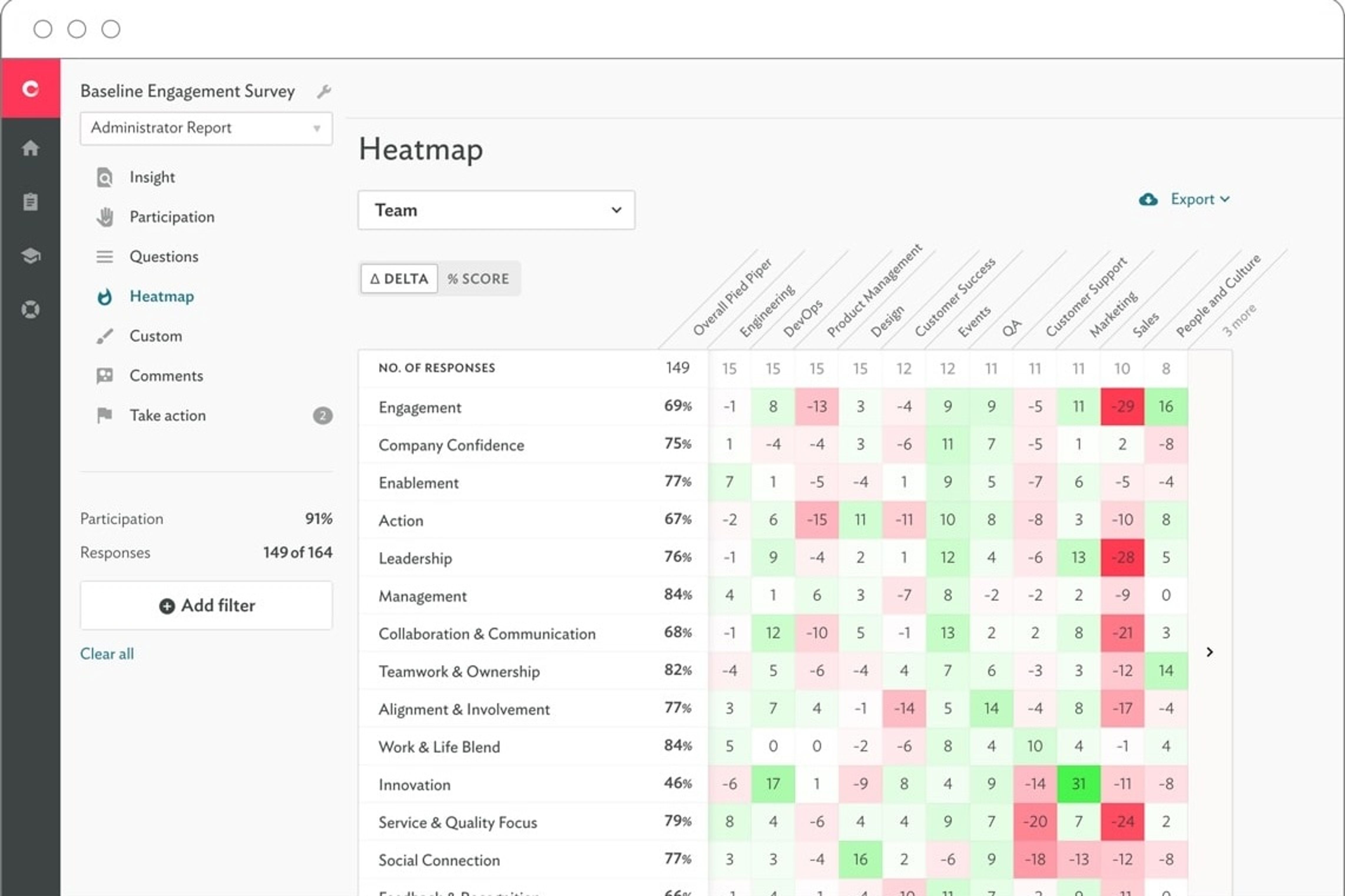
Image source: Culture Amp
Culture Amp combines employee engagement surveys and benchmarks with performance reviews.
Why I chose Culture Amp as a great Lattice alternative
It’s useful when HR wants survey findings to inform both team action plans and performance discussions:
- Engagement surveys and benchmarks provide a consistent way to examine employee sentiment across teams.
- Reviews, analytics dashboards, and action planning connect the listening program with performance and team responses.
Pricing
- Engage / Perform: Custom quote based on employee count, products, and service package; annual billing.
8. Workleap Officevibe
Best use case: Running regular pulse surveys alongside manager conversations.

Image source: Workleap Officevibe
Workleap brings Officevibe’s pulse surveys and team dashboards into a broader performance and engagement platform.
Why I chose Workleap Officevibe as a great Lattice alternative
Regular pulse surveys give managers a way to keep up with employee concerns between larger surveys:
- Pulse surveys and anonymous responses give employees a recurring way to raise concerns.
- 1:1 tools and recognition support team conversations within Workleap’s broader performance and engagement platform.
Pricing
- Standard: US$4,999/year plus US$32/manager/month, billed annually.
9. Cornerstone OnDemand
Best use case: Managing learning, performance, and succession in one enterprise talent suite.

Image source: Cornerstone OnDemand
Cornerstone offers a suite of talent tools spanning performance, learning, and succession planning. It suits companies that want these processes in one talent platform.
Why I chose Cornerstone OnDemand as a great Lattice alternative
I’d consider this broader suite when learning and succession planning need to sit alongside performance management:
- Performance tools and succession planning support decisions about employee growth and future roles.
- Learning, onboarding, and compliance training give an enterprise a wider talent-development setup.
Pricing
- Custom quote for the selected performance, learning, and succession products.
10. Quantum Workplace
Best use case: Combining survey action plans with reviews and ongoing performance conversations.

Image source: Quantum Workplace
Quantum Workplace combines engagement surveys, action planning, and performance tools in one platform.
Why I chose Quantum Workplace as a great Lattice alternative
The useful connection is between hearing employee concerns and managing the response:
- Reviews and goal tracking sit alongside engagement surveys, so the team can use both in performance discussions.
- Action plans, recognition, and manager resources support the response after results are reviewed.
Pricing
- Custom quote: Minimum annual contract of US$15,000; no implementation fee.
11. Microsoft Viva Glint
Best use case: Running organization-wide listening and guided discussions about survey results.

Image source: Microsoft Viva Glint
Microsoft Viva Glint is an employee listening platform for organization-wide engagement and lifecycle surveys. It suits teams that want Microsoft’s survey analysis and guided results discussions.
Why I chose Microsoft Viva Glint as a great Lattice alternative
For HR teams running organization-wide listening, these tools support the discussion after results arrive:
- Engagement and lifecycle surveys support a broader employee-listening program.
- Team analytics, manager insights, and action plans help managers discuss the results and record a response.
Pricing
- Viva Glint: US$2/user/month, paid yearly, with a 50-license minimum.
Main tradeoff: Viva Glint is an employee-listening tool; formal performance reviews require a separate system.
Looking beyond Viva Glint? Compare other employee listening platforms in our Viva Glint alternatives guide.
12. Bonusly
Best use case: Recognizing employee contributions and using those examples in manager check-ins.

Image source: Bonusly
Bonusly encourages peer feedback through recognition and rewards. Its focus is recognizing contributions, with check-ins and performance recaps supporting manager conversations.
Why I chose Bonusly as a great Lattice alternative
Bonusly fits the recognition side of a manager’s job: noticing contributions and bringing examples of good work into conversations.
- Peer recognition and custom rewards make colleagues’ contributions visible, with team insights drawn from that activity.
- Slack and Teams integrations, check-ins, and performance recaps support regular conversations around those contributions.
Pricing
- Team + Bizy: US$50/user/year. Free plan: Up to eight users.
Main tradeoff: Recognition and performance recaps don’t replace configurable formal review cycles. Rewards are charged separately when redeemed.
13. HiBob
Best use case: Managing employee records, onboarding, and performance in one HR system.

HiBob is a modern HR platform that includes performance tools. It’s relevant for growing companies that need employee records and HR administration alongside reviews.
Why I chose HiBob as a great Lattice alternative
HiBob combines core HR and onboarding with talent tools, making it relevant when the replacement also needs to be an HRIS.
- Employee records and onboarding support core HR administration alongside talent processes.
- Performance tools, engagement surveys, and people analytics let HR work with those records in the same platform.
Pricing
- Custom quote: Based on employee count, selected products, and implementation or support services.
Main tradeoff: Performance tools come with Core HR, making Bob a broader HR-system purchase.
How to choose a Lattice competitor
The right Lattice competitor depends on the work you need to improve: flexible performance reviews, employee engagement research, or managers acting on feedback. The sections above compare how each product supports those needs.
I’d shortlist Teamspective if you want managers to connect employee feedback and development discussions to your company's strategy, values, and leadership principles. Lea helps prepare 1:1 agendas, apply company-specific expectations when discussing feedback, and organize follow-up actions. See that manager workflow in a Teamspective demo.
Frequently Asked Questions
Which Lattice competitors are best for performance management versus employee engagement?
PerformYard and Betterworks are useful starting points for configurable review processes and goal alignment. Culture Amp and Microsoft Viva Glint emphasize employee listening and survey analysis; 15Five’s Total Platform combines engagement and performance. Teamspective combines these areas with collaboration analysis and requested manager guidance, so compare the whole workflow rather than assuming the categories are exclusive.
How do Lattice competitors compare on price?
Compare equivalent packages: Lattice Performance is $10 per seat/month and Engagement is $4, billed annually with a $4,000 annual minimum; Foundations, including Goals & OKRs, is $13 before Engagement. 15Five lists Perform at $11 and Total Platform at $16 per user/month annually, while Teamspective Standard starts at €5.50 with module selection affecting the quote. Add platform fees and minimums where listed; Quantum Workplace starts at $15,000 annually.
Which Lattice competitor is best for customizable review workflows?
PerformYard offers configurable review forms, reviewer relationships, approval steps, and reminders. Lattice also supports customization, as its positive reviews show; review administration needs can vary with the complexity of an organization’s process.
Which Lattice competitors suit smaller teams?
For surveys alone, 15Five Engage starts at $4 per user/month annually. For performance reviews, PerformYard lists a $5–15 per person/month range. Teamspective offers a 14-day trial for up to 20 users, making it possible to test its engagement, performance, and leadership enablement workflows with a smaller group. Bonusly's free plan supports up to eight users for recognition. Viva Glint requires 50 licenses, Workleap has an annual base fee, and Quantum Workplace has a $15,000 annual minimum.
Which Lattice competitor should I consider if I only need employee surveys?
Compare 15Five Engage, Culture Amp Engage, and Microsoft Viva Glint for survey design, anonymity, segmentation, benchmarks, and action planning. Teamspective's Engagement module is worth considering if you also want managers to connect survey findings to company leadership principles and prepare meaningful follow-up conversations with Lea. Betterworks offers standalone Engagement with quote-based pricing; its $8 Performance price should not be used as the survey-package price.


