
Top 12 Employee Retention Software Platforms in 2026
April 14, 2026
A comparison of the top 12 employee retention software platforms for 2026 — what each does well, who each is best for, and how to choose the right one for your organization.
Employee retention software helps organizations identify why employees leave, measure engagement in real time, and give managers the data and guidance to act before problems escalate into resignations. The right platform combines pulse surveys, performance feedback, and collaboration analytics — connecting what employees experience to what leaders can do about it.
Key Findings
- Replacing an employee costs between 50% and 200% of their annual salary depending on role level, according to Gallup — frontline roles at the lower end, managers and technical specialists at the upper.
- 42% of voluntary turnover is preventable according to Gallup — employees themselves said their manager or organization could have done something to keep them.
- Employees who feel their voice is heard are 4.6 times more likely to perform at their best, according to Salesforce research.
- 83% of engagement improvements should be addressed at the team level, not through company-wide initiatives — which is why giving every manager visibility into their own team's data matters.
- Platforms that move organizations from annual surveys to continuous listening cycles close the gap between when problems start and when HR finds out.
What Is Employee Retention Software?
At its core, employee retention software helps organizations understand why employees stay or leave. The best platforms provide real-time insights into engagement levels, identify potential flight risks before they become problems, and equip managers with actionable guidance to intervene effectively.
Unlike general HR software that focuses primarily on administrative functions — payroll, time tracking, compliance — retention platforms focus on the human element: measuring satisfaction, engagement, performance, and the quality of collaboration across teams.
Effective employee retention software typically combines:
- Engagement measurement tools (surveys, pulse checks, sentiment analysis)
- Performance management capabilities
- Collaboration analytics
- Predictive HR analytics to identify flight risks
- Leadership enablement tools that help managers take the right action
What makes modern retention platforms genuinely useful is their ability to connect different data points — highlighting, for example, the correlation between specific manager behaviors and team turnover rates, or identifying which teams are struggling with cross-functional collaboration.
Top 12 Employee Retention Software Platforms for 2026
Improve employee retention
Learn how modern people analytics platforms make data collecting and analysis easy, delivering clear insights into what's driving and destroying retention in your organization.
Learn moreCulture Amp
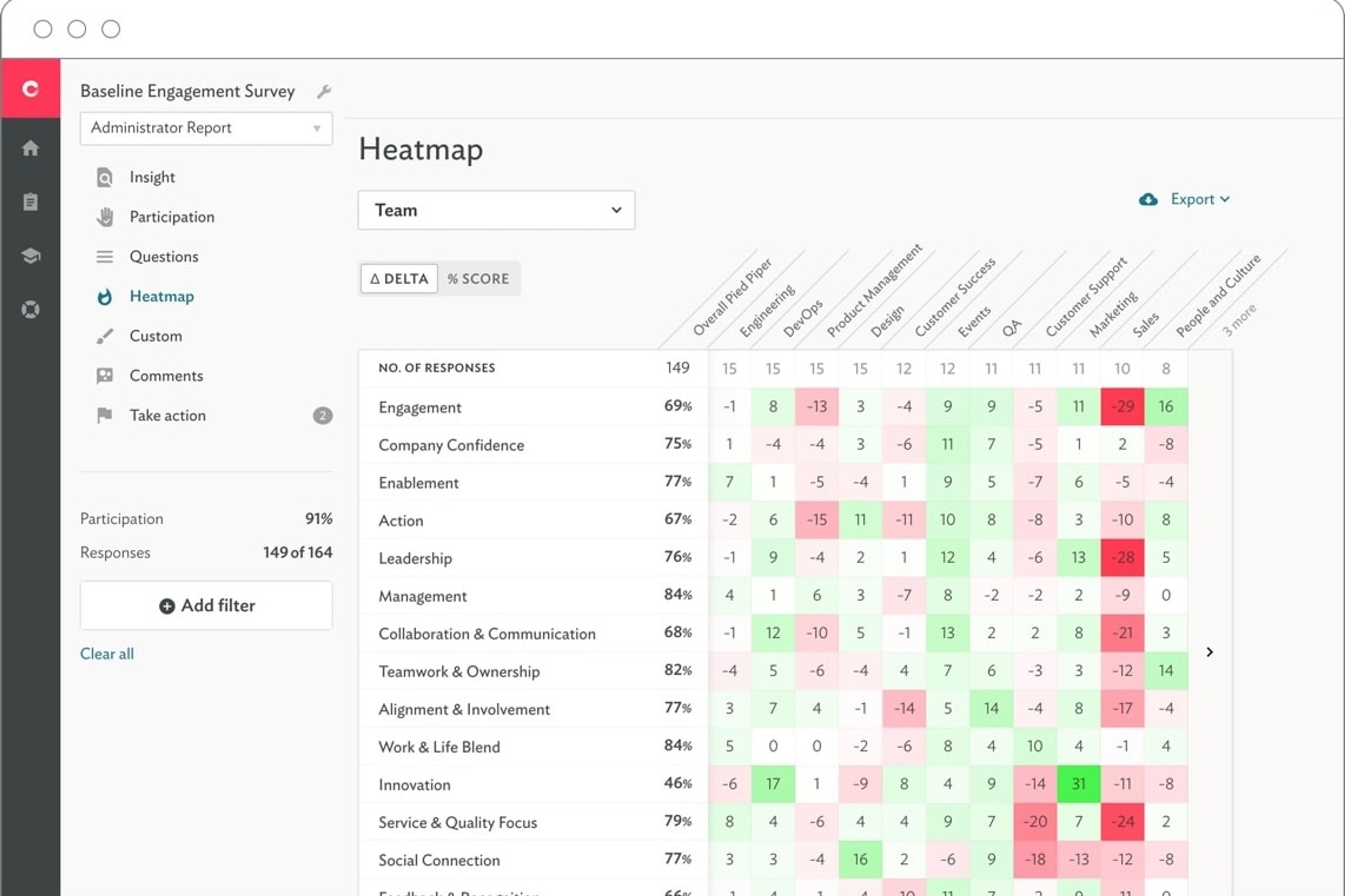
Culture Amp delivers a comprehensive employee experience platform that combines engagement measurement with performance management and development tools. Its science-backed survey approach provides actionable insights into what drives retention in your specific organizational context.
Pros
Research-backed methodology: Surveys designed by organizational psychologists for maximum validity.
Action planning tools: Integrated features to help managers develop meaningful response plans.
Extensive template library: Pre-built surveys for various scenarios throughout the employee lifecycle.
Cons
Feature complexity: The breadth of offerings can be overwhelming for new users.
Report interpretation: Requires training to get full value from the depth of analytical insights.
Mobile experience: Desktop version offers more functionality than the mobile experience.
Best for: Organizations looking to build a data-informed culture with scientific approaches to engagement and retention.
Qualtrics EmployeeXM

Qualtrics EmployeeXM provides enterprise-grade experience management capabilities across the employee lifecycle. Its analytics identify experience gaps that could lead to turnover, while its action planning tools help leaders address identified issues systematically.
Pros
Comprehensive lifecycle coverage: Manages experiences from recruitment through exit.
Powerful text analytics: Advanced natural language processing to analyze open-ended feedback.
Extensive integration ecosystem: Connects with HRIS and other business systems.
Cons
Setup complexity: Requires significant configuration for optimal performance.
Cost structure: Higher price point than many competitors.
Feature scope: Some organizations only use a fraction of available capabilities.
Best for: Enterprise organizations looking for extensive customization and integration with existing business systems.
15Five

15Five offers an intuitive platform that combines lightweight performance management with engagement measurement. Its check-in system promotes regular dialogue between managers and employees, fostering the continuous feedback essential for retention.
Pros
Simple user experience: Designed for weekly usage with minimal time investment.
Conversation facilitation: Structures meaningful dialogue between managers and team members.
Recognition tools: Built-in appreciation features that boost engagement.
Cons
Limited analytics: Less robust data analysis than some enterprise platforms.
Feature depth: Some specialized capabilities may require additional tools.
Customization limitations: Less flexible than some enterprise alternatives.
Best for: Mid-sized organizations prioritizing manager-employee relationships and regular feedback cycles.
Lattice
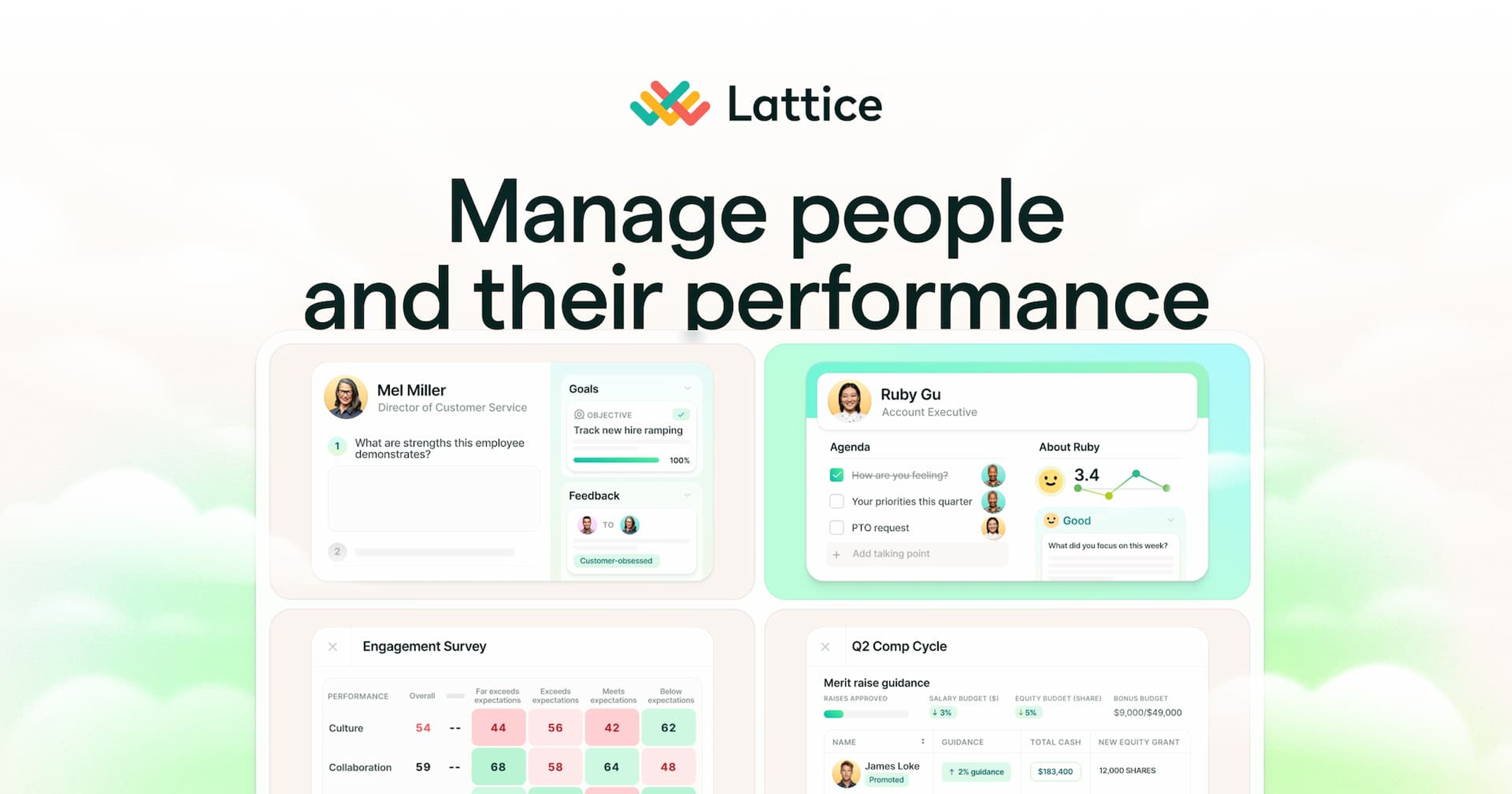
Lattice provides an integrated approach to performance, engagement, and development that helps create a culture of continuous feedback. Its design addresses multiple factors affecting retention in a single platform.
Pros
Goal alignment: Strong OKR and goal-setting features that connect individual work to company mission.
Career development tools: Supports growth conversations and development planning.
User-friendly interface: Clean design that encourages consistent use.
Cons
Module separation: Some features work as separate modules rather than a truly unified platform.
Analytics complexity: Advanced insights may require dedicated data expertise.
Implementation time: Full value realization can take several months.
Best for: Growing organizations looking to build structured performance and development processes alongside engagement measurement.
Workleap

Workleap delivers a focused engagement measurement system through pulse surveys and team health metrics. Its focus on simplicity and actionable insights makes implementation and maintenance straightforward for HR teams.
Pros
Ease of implementation: Quick setup with minimal configuration required.
Anonymous feedback channels: Creates psychological safety for honest input.
Manager-specific insights: Tailored reports to help leaders improve team dynamics.
Cons
Feature depth: Not as comprehensive as some all-in-one platforms.
Limited customization: Survey methodology is somewhat fixed.
Reporting constraints: Less robust analytics than enterprise platforms.
Best for: Organizations seeking a lightweight, focused approach to measuring and improving team engagement.
Bonusly

Bonusly takes a recognition-first approach to retention, enabling peer-to-peer appreciation with tangible rewards. By making contributions visible and celebrated, it addresses the recognition gap that often leads to turnover.
Pros
User adoption: Typically achieves high participation rates across organizations.
Recognition visibility: Makes appreciation public and persistent.
Reward flexibility: Offers various redemption options for points earned.
Cons
Limited scope: Focuses primarily on recognition rather than comprehensive engagement.
Budget management: Requires ongoing financial commitment for rewards.
Culture fit: Works best in organizations already comfortable with public recognition.
Best for: Companies looking to strengthen their recognition culture as part of their retention strategy.
TINYpulse

TINYpulse provides a straightforward approach to employee listening through pulse surveys, virtual suggestions, and peer recognition. Its simplicity makes it accessible for organizations new to systematic engagement measurement.
Pros
Implementation speed: Quick deployment with minimal setup required.
Anonymous suggestion system: Cheers for Peers feature encourages positive feedback.
Benchmark data: Comparison against similar organizations for context.
Cons
Analytics limitations: Less sophisticated data analysis than some alternatives.
Integration constraints: More limited connections to other HR systems.
Survey flexibility: Less customization in survey design and cadence.
Best for: Small to mid-sized organizations implementing their first systematic approach to engagement measurement.
Kudos

Kudos combines recognition capabilities with engagement measurement in a platform designed for simplicity and high adoption. Its focus on positive reinforcement helps create a culture where people feel valued and choose to stay.
Pros
Ease of use: Intuitive interface requiring minimal training.
Culture reinforcement: Connects recognition to specific organizational values.
Resource efficiency: Doesn't require extensive HR administration.
Cons
Feature scope: More focused on recognition than comprehensive retention.
Analytical depth: Limited compared to dedicated analytics platforms.
Enterprise scalability: May not meet all needs of complex organizations.
Best for: Organizations focused on strengthening culture and recognition as retention drivers.
Engagedly

Engagedly offers a performance-centric approach to retention, combining goal management, feedback, and learning in a unified platform. It addresses the critical role that growth and development play in employee decisions to stay.
Pros
Performance alignment: Strong capabilities for goal setting and tracking.
Learning integration: Connects performance gaps to development opportunities.
Social recognition: Built-in appreciation features that boost engagement.
Cons
User experience complexity: Interface can be busy with many features.
Mobile limitations: Desktop experience is more robust than mobile.
Implementation support: May require consulting help for optimal setup.
Best for: Organizations focusing on performance management and development as primary retention drivers.
Glint (Microsoft Viva)

Now part of Microsoft Viva, Glint provides sophisticated people analytics that connect engagement data to business outcomes. Its predictive capabilities help identify potential turnover risks before they become problems.
Pros
Predictive analytics: Data-driven insights that forecast potential issues.
Microsoft ecosystem integration: Direct connection with Microsoft 365.
Action planning tools: Structured approach to addressing identified issues.
Cons
Microsoft dependence: Best value realized within the Microsoft environment.
Implementation complexity: Requires significant setup for maximum benefit.
Cost considerations: Premium pricing for advanced capabilities.
Best for: Microsoft-centric organizations seeking advanced analytics integrated with their existing productivity suite.
Workday Peakon
Workday Peakon is a continuous listening platform that combines advanced analytics with extensive industry benchmarking. It is part of the Workday suite, which makes it a natural fit for organizations already on Workday HRIS.
Pros
Advanced data visualization and benchmarks that connect engagement to business outcomes.
Flexible survey cadence from annual to continuous pulse.
Deep integration with Workday HRIS for organizations already in that ecosystem.
Cons
Requires significant setup and configuration.
Premium pricing that can be challenging for mid-market organizations.
Managers face a learning curve to use the advanced features independently.
Best for: Large enterprises already on Workday seeking data-driven engagement measurement.
Teamspective
Teamspective is a leadership enablement platform that combines pulse surveys, 360 feedback, and organizational network analysis (ONA) in a single platform. It runs natively inside Slack and Microsoft Teams, which drives higher response rates without requiring employees to log into a separate tool. ONA maps real collaboration patterns across teams, surfacing hidden silos and bottleneck risks that engagement surveys alone cannot detect.
Pros
Combined view of engagement, performance, and collaboration (ONA) data in one platform — no separate tools or data exports required
Native Slack and Microsoft Teams delivery drives higher response rates and lower admin overhead
Organizational network analysis reveals hidden silos and collaboration bottlenecks that pulse data alone would miss
60+ HRIS integrations; typically implements in approximately 15 minutes
Cons
No OKR setting and tracking
No whitelabeling available
ONA requires clear internal communication around data privacy, as network analysis can be new to employees
Best for: Organizations with 30+ people managers wanting continuous, team-level engagement intelligence combined with collaboration visibility.
How the Top 12 Platforms Compare
| Platform | Best for | Company size | Slack/Teams native | ONA | Standout capability |
|---|---|---|---|---|---|
| Teamspective | Leadership enablement, ONA | 500–5,000 | Yes | Yes | Combines engagement + performance + collaboration in one platform |
| Workday Peakon | Enterprise analytics | 1,000+ | No | No | Deep benchmarking and continuous listening |
| Culture Amp | Data-informed culture building | 200–10,000+ | No | No | Science-backed surveys, extensive template library |
| Qualtrics EmployeeXM | Large enterprise, full lifecycle | 1,000+ | No | No | Powerful text analytics, broad HRIS integrations |
| 15Five | Manager-employee relationships | 100–2,500 | No | No | Weekly check-ins and lightweight performance |
| Lattice | Performance + engagement combo | 50–1,000+ | No | No | OKR tracking alongside engagement |
| Workleap | Simple pulse measurement | 50–1,500 | No | No | Fast setup, anonymous feedback channels |
| Bonusly | Recognition-first retention | 50–1,000 | Yes | No | Peer-to-peer appreciation with rewards |
| TINYpulse | First-time engagement users | 30–500 | No | No | Anonymous suggestion system |
| Kudos | Culture and recognition | 50–1,000 | No | No | Values-linked recognition |
| Engagedly | Performance + learning | 50–1,000 | No | No | Goal management connected to development |
| Glint (Microsoft Viva) | Microsoft-centric organizations | 500+ | MS Teams | No | Predictive analytics within Microsoft 365 |
Table data reflects publicly available information as of May 2026. Product capabilities, pricing, and company size recommendations are subject to change. Always verify current details directly with vendors before making a purchasing decision.
The Benefits of Employee Retention Software
Replacing an employee typically costs between 50% and 200% of their annual salary according to Gallup — which for mid-level roles in Europe commonly translates to €20,000–50,000 when you factor in recruitment, onboarding, and lost productivity. Reducing turnover is only one of several benefits a dedicated retention platform delivers.
Reducing Turnover Rates
The cost of voluntary turnover is estimated at between 33% and 200% of the departing employee's salary, depending on skills and seniority level.
Employee retention software helps identify and address potential gaps in employee experience before they turn into actual problems. Addressing employee needs proactively rather than responding to exits one by one reduces overall turnover rates over time.

Decreasing the Impact of Knowledge Loss
Reducing Recruitment Costs
Organizations with robust retention analytics can predict and prevent departures, reducing urgent hiring needs and the premium paid for expedited recruitment. Companies known for strong employee satisfaction also spend less on recruitment marketing while attracting more qualified applicants — a direct consequence of lower voluntary turnover.
Increasing Employee Engagement and Productivity
Moving from annual surveys to continuous feedback cycles changes what HR can act on. Workers who feel heard are 4.6 times more likely to perform at their best according to Salesforce research — and 42% of voluntary departures are preventable according to Gallup, meaning employees themselves said something could have been done to keep them.
Visibility Into Organizational Health
Retention platforms transform complex workforce data into clear visualizations that support better decision-making at all leadership levels. This accessibility shifts retention management beyond HR to the operational leaders who can most directly influence employee experience — and it moves the work from reactive to proactive.

Impact on Employee Retention and Satisfaction
Regular feedback cycles are critical for sustaining engagement. When employees feel their voices are heard and their concerns addressed, they develop a stronger sense of belonging and investment in the organization.
The most effective retention strategies involve systematic approaches to identifying engagement trends before they become retention problems. Platforms that surface collaboration patterns — such as a team becoming increasingly isolated — can catch warning signs that surveys alone would miss.
The psychological safety that develops from systematic feedback is material for retention. When employees feel comfortable sharing their thoughts and concerns without fear of negative consequences, they are more likely to work through challenges rather than seek opportunities elsewhere.
The key to lasting impact is connecting employee satisfaction to tangible business outcomes. The best retention platforms don't just measure how people feel — they track how those feelings correlate with performance, collaboration efficiency, and business results. That connection is what transforms retention from an HR initiative into a measurable business priority.
Measuring ROI and Success
The financial case for investing in retention software is straightforward. Gallup puts replacement costs at 50–200% of annual salary per employee — which for mid-level roles in Europe typically means €20,000–50,000 per departure when you account for recruitment, onboarding, and productivity loss. For specialized or senior roles, this figure can easily double.
When evaluating the effectiveness of a retention platform, the key performance indicators to track include:
- Reduction in turnover rate
- Improvement in engagement scores
- Decrease in time-to-fill positions
- Increase in internal promotions
- Improvement in productivity metrics
A useful framework for quantifying the return is employee lifetime value (ELTV) — how long employees stay and how productive they are throughout that time. Organizations can apply this by asking: does improved onboarding get new hires to full productivity faster? Are more people staying and succeeding over their first two years?

The next level of measurement is collaboration efficiency — how well teams are working together and whether they are achieving shared goals. Platforms with organizational network analysis make this visible in a way engagement surveys alone cannot.
When evaluating total cost of ownership, look beyond the license fee. The admin time required to run and maintain a platform is real cost. Free workarounds such as Google Forms or spreadsheets often cost more in practice once manual effort is properly accounted for.
Choosing the Best-Fit Employee Retention Software
Employee retention software has become a standard part of the modern HR tool stack. The right evaluation question is not whether to invest, but which capabilities matter most for your organization's specific context — size, industry, existing tools, and whether your priority is engagement measurement, performance feedback, collaboration visibility, or all three.
Organizations still relying on annual surveys or exit interviews to understand why people leave are working with data that is months too late. The platforms reviewed in this article give HR teams and managers a continuous picture — which means earlier signals, earlier action, and better outcomes.
If your organization has 30 or more people managers and wants to move beyond periodic surveys toward continuous, team-level retention intelligence — including organizational network analysis — Teamspective is worth evaluating. Teams where managers actively use the platform show 15–20% higher engagement and 30% higher teamwork scores than the organizational average.
Originally published 14 April 2026. Last updated 25 May 2026.
Frequently Asked Questions
What is employee retention software?
Employee retention software is a category of HR technology that helps organizations measure engagement, identify flight risks, and give managers the data and guidance to act before problems escalate into resignations. The best platforms combine pulse surveys, 360 feedback, performance data, and collaboration analytics in one place — rather than leaving HR to piece together signals from separate tools.
How much does it cost to replace an employee?
Gallup estimates replacement costs at 50–200% of an employee's annual salary, depending on role level. The wide range reflects the difference between replacing a frontline worker (roughly 40–50% of salary) and a manager or technical specialist (80–200%). These figures include direct costs — recruitment, onboarding, training — as well as indirect costs like lost productivity during the vacancy and ramp-up period.
What is the difference between employee retention software and an HRIS?
An HRIS manages administrative HR processes: payroll, benefits, compliance, org structure. Employee retention software focuses on the human experience: how engaged people are, how effectively teams collaborate, and what managers can do to improve both. The two categories integrate well but serve different functions — an HRIS tells you who works at the company and on what terms; retention software tells you how they feel about it and what is likely to happen next.
How often should employee pulse surveys run?
Most organizations running continuous listening programs use bi-weekly or monthly pulse surveys — short enough (2–5 questions) that response rates stay high, frequent enough that trends are visible before they become problems. Annual engagement surveys still have a role for longer-form benchmarking, but they should be supplemented with higher-frequency pulses rather than used as a standalone measure.
What is organizational network analysis (ONA) and why does it matter for retention?
Organizational network analysis maps how employees actually communicate and collaborate — not based on org chart reporting lines, but on real interaction patterns from tools like Slack, Teams, and email. For retention, ONA reveals hidden silos, bottleneck individuals carrying disproportionate collaboration load, and onboarding gaps where new hires are not yet integrated into team networks. These patterns often predict disengagement and departure before any survey would catch them.


