10 Best Culture Amp Alternatives to Help Managers Act on Employee Feedback
November 5, 2026
Compare 10 Culture Amp alternatives by how they help managers act on employee surveys. Explore use cases, pricing, and limitations to build your shortlist.
AI summary
- Across the 106 Culture Amp reviews we analyzed on G2 and Capterra, users described frustration with complicated review workflows, difficulty navigating reports, and limited flexibility to fit existing processes.
- Choosing the right alternative depends on how well it helps you turn survey results into action and whether its approach works for your team. Consider how a manager will discuss a result, assign a next step, and check progress.
- Teamspective is a leadership enablement platform that combines employee engagement, performance, and collaboration. It helps every manager act on those insights inside Slack and Microsoft Teams.
Disclosure: This guide is published by Teamspective. We’ve included our platform alongside competitors and evaluated each against the same criteria. Descriptions are based on publicly available product information, vendor documentation, and pricing as of October 19, 2026. Our assessment of Culture Amp also draws on 106 verified G2 and Capterra reviews.
Most employee engagement tools collect and analyze survey results well. In my experience, the hard part is helping managers and leaders understand what truly deserves attention.
Take the Quantum Workplace’s panel study, for instance. Of 1,068 employees, roughly two-thirds said their organization fell short at acting effectively on survey results. Gallup’s survey of 15,000 employees also found that only 16% described their last conversation with their manager as extremely meaningful.
Platforms like Culture Amp are designed to solve this problem. But some of the Culture Amp reviews I found highlight a few issues that might make it difficult for leaders to follow through with meaningful actions:
- Reporting limits that create extra analysis work. A senior talent acquisition consultant describes needing to export data and work outside the platform when standard filters and built-in interpretation don’t provide enough depth.
- Complicated review workflows. Nominating reviewers, collecting feedback, and managing the administrative steps made 360 reviews cumbersome for Christoph B., a chief operations officer.
- Limited use between formal cycles. Beyond the twice-yearly cycles, people at one mid-market company weren’t returning to the platform. The reviewer praised Culture Amp’s analysis but said other capabilities went unused.
If those frustrations sound familiar, you’re in the right place. In this article, we compare 10 Culture Amp competitors, focusing on how each supports managers in turning feedback into practical changes in how they lead.
2026 Comparison: 10 Culture Amp alternatives by best fit, price, and notable limitations
| Tool | Best for | Price | Notable limitations |
|---|---|---|---|
| Teamspective | Organizations that want managers acting on engagement, performance, and collaboration data inside Slack and Microsoft Teams. | Standard from €5.50/seat/month; Enterprise custom | Doesn’t include a standalone module for goal setting and OKR management. |
| Lattice | Connecting performance reviews and ongoing feedback with goals and OKRs | Foundations $13/seat/month; Engagement $4/seat/month, billed annually | Engagement and career-development products cost extra. $4,000 minimum annual agreement. |
| Leapsome | Connecting reviews and feedback with development goals and learning | Published module rates: Reviews €7, Surveys €4/employee/month | Platform tier and additional modules affect the total. Learning and goals are separately priced modules. |
| 15Five | Combining regular check-ins, performance reviews, and manager development | Perform $11/user/month; Total Platform $16, billed annually | Engagement surveys require Engage or Total Platform. Live coaching and Kona AI products cost extra. |
| Workleap | Turning survey comments and review feedback into conversations and action plans | Standard from $4,999/year + $32/manager/month; Enterprise custom | The annual platform fee adds a fixed commitment alongside manager charges. |
| Qualtrics Employee Experience | Giving managers their teams’ survey results and tracking who owns the response | Custom quote | Administrator configuration and permissions determine which planning tools managers can access. |
| Microsoft Viva Glint | Helping managers present survey results and agree on improvements with their teams | $2/user/month, paid yearly | 50-seat minimum. Combining sentiment with Viva Insights workplace analytics requires an additional license. |
| TINYpulse by WebMD Health Services | Anonymous employee feedback, suggestions, and two-way follow-up | Custom quote | Pricing requires a quote. Check which coaching and action-planning support is included in your package. |
| Bonusly | Recognition-led feedback, manager 1:1s, and performance recaps | Team $5/user/month; Organization custom; limited free plan | Rewards spending is separate from the subscription; company-wide analytics and SAML SSO require the Organization plan. |
| Quantum Workplace | Assigning ownership and tracking team actions after engagement surveys | Custom quote based on organization size and selected tools | Its suggested-action library is unavailable for custom survey questions; teams can create custom actions instead. |
Detailed Culture Amp alternatives review; based on their best use case.
1. Teamspective
Best use case: Organizations that want every manager, not only HR, acting on engagement, performance, and collaboration data inside Slack and Microsoft Teams.
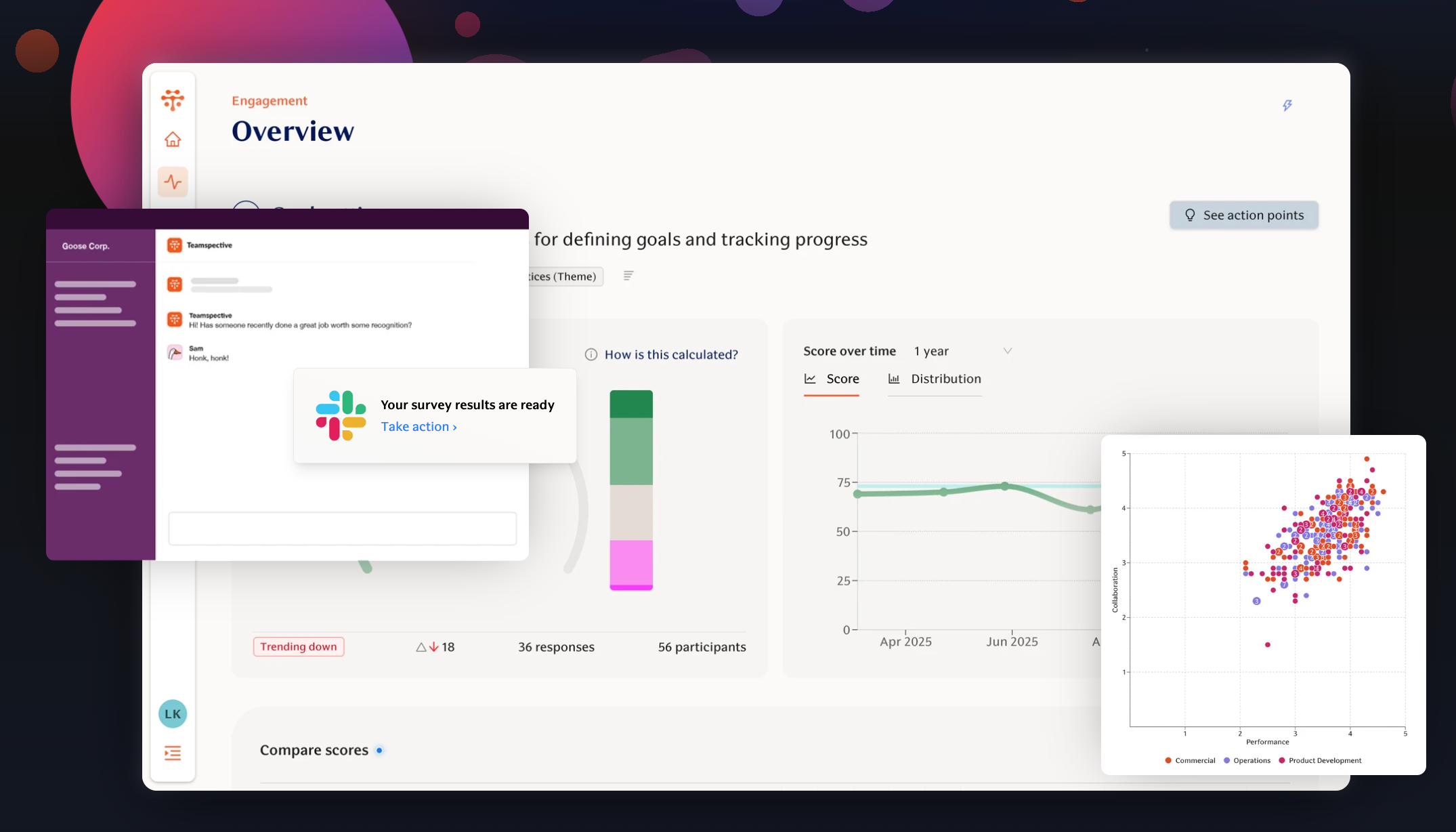
What it does: Teamspective is a leadership enablement platform that combines employee engagement, performance, and collaboration. Every leader gets guidance to follow up on employee engagement, performance, goals, growth discussions, and strategic changes. Managers can use team survey results and development feedback to prepare a 1:1, ask for help wording feedback, and save the next steps they agree with an employee.

Image source: Teamspective product overview
Lea, Teamspective's Leadership Enablement Agent, uses team data and the company’s leadership principles. Every manager gets Lea. A manager can ask what has changed in the team’s motivation, then use the response to decide what to raise at the next meeting.
Why I chose Teamspective as a great Culture Amp alternative
I chose Teamspective for its focus on turning people data into leadership action. If you’re tired of preparing annual survey reports that don’t lead to action, and need a Culture Amp alternative that helps leaders take that work forward themselves, here’s how Teamspective helps.
1. Company-specific leadership guidance
If you’re tired of generic best practices that don’t reflect your company’s priorities, or recommendations that still leave managers figuring out what that means for their team, Teamspective helps.
With Teamspective, managers give useful feedback, communicate expectations clearly, and address team concerns in ways that reflect the company’s priorities and leadership principles.
Before collecting people data, the platform is configured with your strategy, goals, values, and leadership framework, alongside team structures pulled from your HR system.
That way:
- Every survey question reflects your company’s language and priorities, helping you examine issues relevant to your organization.
- Leadership feedback, such as 360 feedback, uses your own competencies to assess managers against the behaviors your company expects.
- Meeting agendas, feedback coaching, and recommended actions reflect your company’s strategy, values, and leadership principles.
Now, you don’t have to step in to supply the missing context all the time.
2. You can use Lea to prepare conversations and create follow-up actions
Culture Amp’s AI Coach in Surveys suggests actions from survey results. Lea works from your own strategy, values, and leadership principles, and acts: it prepares the conversation, coaches the feedback, and records what was agreed.
With Lea, managers can:
- Prepare the conversation: Lea pulls together feedback, development priorities, and previous commitments into a 1:1 agenda.
- Apply company expectations: It phrases feedback using your organization’s leadership principles, so the conversation reflects the behaviors managers are expected to encourage.
- Record the next steps: save discussion notes and create or update follow-up tasks, with confirmation before changes are made.

Lea’s suggested-action and meeting-booking workflow.
Additionally, Lea can suggest a goal-setting conversation, offer available meeting times, and create the event after the manager chooses one, making it easy to turn recommendations into a scheduled conversation.

3. Bring feedback and manager routines into existing tools
Teamspective’s integrations with Microsoft Teams and Slack let employees answer pulse and network surveys and give feedback directly in either platform. The walkthrough below shows the Slack experience: employees select responses and add comments without leaving Slack.

Answering an engagement survey inside Slack. GIF excerpt from Teamspective’s published demo.
Managers can use Lea in Microsoft Teams, Slack, or the Teamspective web app to prepare for a 1:1 or ask about changes in their team’s survey results.
Separately, Teamspective connects with 60+ HR systems through Kombo, its HR integration partner. This keeps the team structure behind reports and Lea’s guidance current without HR updating employee lists and manager assignments in two places. HR controls which employees and data fields are imported.
Pricing
- Standard: starting at EUR 5.50 per seat/month, up to 300 seats, price scales with modules.
- Enterprise: custom quote, 300+ seats.
- Free trial: 14 days, 20 seats, all core modules, no credit card.
Book a Demo
See how Teamspective could support your managers. Book a demo to explore the survey, feedback, and collaboration workflows your team would use.
Schedule DemoWant to dig deeper? Read our Culture Amp vs Teamspective comparison to see how the two platforms help managers turn survey feedback into action.
2. Lattice

Best for: Managers who run regular 1:1s and need better tracking for goals and review feedback.
Lattice brings reviews, goals, 1:1s, and engagement surveys into its HR platform. I’d consider it when managers need to revisit agreed goals and feedback between formal review cycles.
Why I chose Lattice as a great Culture Amp alternative
I’d shortlist Lattice if you want to adapt performance reviews to your existing process and keep development conversations going between review cycles. These features stood out during my review:
- Configurable review templates and workflows let you tailor the process to annual assessments, quarterly development conversations, or project-based feedback.
- 1:1s and weekly Updates give you and your team a regular place to discuss progress and revisit commitments between formal reviews.
- Ongoing feedback lets your team share observations throughout the year, supporting development conversations beyond scheduled review cycles.
- Goals & OKRs help your team track progress against agreed priorities and give those conversations a concrete reference point.
Pricing
- Foundations: $13 per seat/month, including Performance, Goals & OKRs, and manager tools.
- Engagement: an additional $4 per seat/month.
- Grow: an additional $4 per seat/month for career development.
- Billing: annual contracts, with a $4,000 minimum annual agreement.
3. Leapsome
Best for: Turning review feedback into learning goals and checking progress in 1:1s.

Leapsome combines reviews, goals, and meeting tools with a Learning module. I’d shortlist it for employee development that continues after the review: agreed goals, assigned learning, and progress discussed in later meetings.
Why I chose Leapsome as a great Culture Amp alternative
I’d shortlist Leapsome if you want performance reviews to lead to assigned learning, with progress discussed in later 1:1s. I particularly like how these features support that process:
- Learning paths linked to development goals help you assign training to address skill gaps identified in reviews, then track progress and completion.

Image source: Leapsome Learning Path
Shared meeting agendas and action items give you and your team a place to record decisions, assign next steps, and revisit earlier conversations.
- Goals alongside the meeting agenda let you discuss progress and obstacles during a 1:1, keeping the conversation connected to what the employee agreed to work on.
Pricing
- Performance Reviews: €7 per employee/month.
- Learning: €4 per employee/month.
- Goals & OKRs: €4 per employee/month.
- Engagement Surveys: €4 per employee/month.
These are module prices. Your total depends on the platform tier and modules you select.
4. 15Five

Best for: Managers who want to discuss weekly obstacles and revisit commitments in 1:1s.
15Five supports ongoing feedback through weekly check-ins, alongside performance reviews and engagement surveys.
Why I chose 15Five as a great Culture Amp alternative
15Five is worth considering if you want a routine for managers to discuss feedback and revisit commitments between formal reviews. Its check-in and 1:1 tools support that routine in several ways:
- Weekly check-ins give your team a routine for raising obstacles and sharing progress. You can move an employee’s answer into the next 1:1 agenda or flag it for follow-up.

Image source: 15Five Check-ins
- Shared 1:1 agendas bring talking points, notes, and action items together, helping you revisit what you agreed in the previous conversation.
- Saved wins and challenges let you retain examples from check-ins for later performance reviews, giving those discussions context from throughout the year.
- Engagement action plans help you respond to survey results by assigning tasks, discussion topics, or objectives to your team.
Pricing
- Engage: $4 per user/month for engagement surveys and action planning.
- Perform: $11 per user/month, including performance reviews, weekly check-ins, and 1:1 tools.
- Total Platform: $16 per user/month, combining Engage and Perform.
- Billing: all plans are billed annually.
5. Workleap (formerly Officevibe)

Best for: Managers who need to respond to recurring survey comments and follow up on a plan.
Officevibe is now part of Workleap. Its Team Health & Feedback tools collect pulse responses and anonymous comments; managers can use those findings to prepare conversations and action plans.
Why I chose Workleap as a great Culture Amp alternative
Workleap suits former Culture Amp users who want recurring engagement surveys to inform everyday manager decisions. Its Team Health & Feedback tools support this through:
- Pulse surveys give you a recurring view of how your team is feeling, helping you spot changes in engagement over time.
- Anonymous comments give employees a way to explain their concerns and share context about what isn’t working.
- Team-level reports help you look beyond the headline engagement score. In the report above, alignment and recognition stand out as areas to investigate despite the strong overall score.
- The Workleap agent summarizes survey themes and suggests responses using HR’s guidelines, helping you decide what to address and how to respond.
Pricing
- Standard: starts at $4,999 USD/year, plus $32 per manager/month.
- Pro: starts at $11,999 USD/year, plus $32 per manager/month.
- Enterprise: custom pricing for organizations with more than 250 employees.
- Billing: plans are billed annually.
6. Qualtrics EmployeeXM

Best for: HR teams coordinating survey follow-up across business units and management levels.
Qualtrics Employee Experience supports survey analysis across business units, with configurable dashboards and action planning. I’d consider it when each manager needs their team’s results, and HR needs to track who is responsible for responding across the business.
Why I chose Qualtrics EmployeeXM as a great Culture Amp alternative
For HR teams running surveys across business units, EmployeeXM's Manager Assist gives each manager a place to review results and plan a response. Three features help coordinate that work:
- Manager Assist dashboards let your managers access their employee experience results in one place, according to the permissions your administrator sets.
- Idea boards give your team a place to bring together suggestions before deciding how to respond to the survey findings.
- Action-planning reports show owners, due dates, status, and progress. HR can check who has committed to a response and whether the work is moving forward.
An administrator must activate Manager Assist, enable the relevant pages, and set permissions. To assess fit, use your intended reporting lines: which teams’ results can a manager see, who can create an action plan, and can HR check progress across the business?
Pricing
- Employee Experience: custom pricing through a sales quote.
- Scope the quote: specify the employee engagement, lifecycle, and development capabilities you need
7. Microsoft Viva Glint

Best for: Managers who need to discuss engagement results and agree on a team action plan.
Microsoft Viva Glint gives managers their team’s survey results and materials to discuss them with employees. It sits within Microsoft’s Viva product family.
Why I chose Microsoft Viva Glint as a great Culture Amp alternative
I’d shortlist Viva Glint if the survey-to-team discussion process is your priority within a Microsoft-based setup. These features help you move from presenting results to agreeing on a response:
- Personalized presentations bring your team’s survey results into a presentation you can use to explain the findings, instead of building the discussion material from scratch.
- Guided Team Conversations help you work through the results with your team, choose a focus area together, and agree on the next step.
- Recommended actions and learning resources give you options to consider once you have chosen the issue to address. You can add suggested actions to the team’s plan.
Pricing
- Viva Glint: $2 USD per user per month, paid yearly, with a 50-seat minimum.
- Viva Workplace Analytics and Employee Feedback: $6 USD per user per month, paid yearly. Includes Glint, Insights, and Pulse.
8. TINYpulse
Best for: Leaders who need to ask follow-up questions about anonymous employee feedback.
TINYpulse by WebMD Health Services combines employee surveys, anonymous feedback, and recognition tools.
Why I chose TINYpulse as a great Culture Amp alternative
TINYpulse is relevant if your priority is keeping an open dialogue with employees and responding to concerns as they arise. Its tools give you several ways to keep that conversation going:
- Anonymous two-way communication lets you ask follow-up questions about an employee’s concern without revealing their identity in the conversation. You can ask for more context before deciding what to do.
- Suggestions give employees a channel for proposing improvements, alongside the questions you ask in surveys.
- Cheers for Peers lets colleagues recognize each other’s contributions. The Cheers dashboard below shows recognition activity and frequent senders, giving you a view of who is participating.

WebMD Health Services also describes tailored action planning with expert guidance, which may suit HR teams that want support deciding how to respond to their results.
Pricing
- TINYpulse: contact WebMD Health Services for a quote.
- Included support and terms: confirm the tools, support, and contract terms directly. The public engagement page does not publish subscription rates.
9. Bonusly
Best for: Recognizing employees’ contributions and discussing them in manager check-ins.
Employees use Bonusly to recognize colleagues’ contributions and attach rewards. Managers can bring recognition, wins, and follow-up items into recurring check-ins and 1:1s.
Why I chose Bonusly as a great Culture Amp alternative
Bonusly is worth considering when the behavior you want to encourage is more regular recognition and better everyday manager conversations. Here are the features I’d focus on:
- Peer recognition makes specific contributions visible. In the screenshot below, a colleague thanks someone for helping launch a marketing campaign and tags the contribution with a company value. That gives you a concrete example to revisit in a performance conversation.

- Weekly check-ins let employees rate their week and share context ahead of a 1:1, so you can see what needs attention before the conversation begins.
- Shared 1:1 agendas and notes bring recognition, updates, and follow-ups into recurring discussions. You and your team members can prepare talking points together and record what you agree to do next.
Pricing
- Free: supports up to eight users.
- Team: advertised at $5 USD per user per month.
- Organization: custom pricing.
10. Quantum Workplace

Best for: HR teams that need to see who owns each team’s survey response and whether actions are complete.
After a survey, Quantum Workplace lets managers choose a focus area, add actions, and track completion. HR can see which plans are progressing and follow up with the named owner.
Why I chose Quantum Workplace as a great Culture Amp alternative
Quantum Workplace is worth considering if you want clear ownership and visibility after an engagement survey. Its action-planning tools help you decide what to work on and keep track of the response:
- Recommended focus areas and conversation starters help you move from a survey score to a team discussion. The screenshot below shows a suggested focus area, “My opinions seem to count at work,” alongside an option to open conversation starters and a label showing it has been added to a plan.

- Action plans with named owners let you break a focus area into action items and capture discussion notes. Each plan has one accountable owner, with contributors and viewers as needed.
- Progress dashboards and nudges show plan status and action-item completion. HR can follow up with plan owners through email and in-app notifications, with a message explaining what needs attention.
Pricing
- Quantum Workplace: custom quotes based on your organization’s size and the tools selected.
How to choose a Culture Amp alternative
Start with the work you want to improve: acting on engagement results, holding regular check-ins, managing formal reviews, or supporting employee development. A tool that fits one of those jobs may not replace every part of your current Culture Amp setup.
- Shortlist Teamspective when managers need help preparing conversations from team feedback and keeping track of agreed actions.
- Lattice is relevant for revisiting review feedback and goals in regular check-ins;
- Leapsome adds assigned learning that managers can discuss at later meetings.
A focused listening or recognition tool may be enough if that is the part of Culture Amp you need to replace.
Frequently Asked Questions
Which Culture Amp alternative is best for small teams?
Start with the capabilities you need and the minimum commitment. Teamspective’s Standard plan covers up to 300 seats and starts at €5.50 per seat per month, with modules selected separately. Lattice has a $4,000 minimum annual agreement, while Viva Glint has a 50-seat minimum. A low per-seat price can still mean a larger commitment than a small team needs.
Which Culture Amp alternative should I consider if I only need employee surveys?
15Five Engage offers engagement surveys, benchmarks, and action planning at $4 per user per month, billed annually. TINYpulse is another option for employee listening and anonymous two-way follow-up, with pricing by quote. Viva Glint suits teams seeking engagement surveys and guided team conversations, subject to its 50-seat minimum. Compare these listening-focused options before paying for a full performance suite.
Which Culture Amp alternatives support ongoing manager check-ins?
15Five supports weekly check-ins that can feed into 1:1 agendas and follow-up items. Lattice combines 1:1s, updates, and goals with formal performance processes. Teamspective’s Lea helps managers prepare discussions using relevant team data and record follow-up actions. In a demo, ask each vendor to show how an unresolved item carries into the next conversation.
Which Culture Amp alternative connects performance reviews with employee development?
Leapsome is worth considering when you want reviews to inform learning paths and development goals. Lattice combines performance processes and goals with its Grow career-development product. Check the required modules: learning, engagement, and development capabilities may be priced separately from performance reviews.
Which Culture Amp alternatives fit teams already using Microsoft Teams?
The right choice depends on the task. Teamspective supports using Lea in Microsoft Teams for manager guidance and discussion preparation. Bonusly integrates with Teams for recognition. Viva Glint is Microsoft’s employee-listening option; combining it with Viva Insights workplace analytics requires additional licensing. Ask vendors to demonstrate the exact tasks users can complete in Teams.
How should I compare the total cost of Culture Amp alternatives?
Calculate the annual cost for your actual headcount and required workflow. Include base subscriptions, module fees, manager licenses, minimum commitments, implementation, and any coaching add-ons. For recognition products such as Bonusly, include rewards spending separately. Ask quote-based vendors to itemize the same requirements so you can compare like-for-like packages.